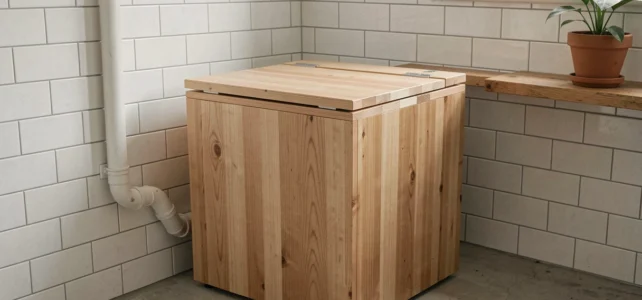
Dry toilets do not appear in any Ikea catalog. The Swedish brand does not manufacture waterless sanitation, and no official announcement suggests a change in direction. This observation is not surprising when one knows Ikea’s positioning on modular furniture for the general public, far from non-collective sanitation equipment.
What circulates online under the name “Ikea dry toilets” actually refers to setups created by individuals using storage furniture, stools, or chests repurposed from their original function. The interest in this approach deserves to be examined beyond simple DIY hacks, especially in light of recent regulatory developments regarding domestic water management in France.
Dry toilets and regulations in France: what the texts allow
The French legal framework explicitly recognizes dry toilets. The decree of September 7, 2009, amended in 2012, incorporates them into non-collective sanitation systems provided that the waste is composted on the property and that the compost is not used for vegetable crops intended for sale.
Choosing Ikea dry toilets for the home thus means assembling a system that must comply with these same obligations, regardless of the furniture used as a structure.
A point often absent from online discussions: the decree no. 2024-796 of July 12, 2024 has opened a common legal framework for the use of non-potable water (rainwater, gray water) in housing. Supply for flush toilets, floor washing, these uses are now regulated under strict sanitary conditions, with separate networks and mandatory signage.
For households that maintain traditional toilets in one room and install dry toilets in another, this regulatory evolution allows for mixed combinations of rainwater and dry toilets on the same property, significantly reducing dependence on the drinking water network.

Repurposing an Ikea piece of furniture into a dry toilet: concrete technical limits
The principle is simple: a storage box or a stool-chest receives a removable bucket, a seat cut from the top plate, and a rudimentary ventilation system. DIY forums extensively document these setups, often using Ikea furniture for their low cost and availability.
What the furniture actually provides
An Ikea storage chest offers a lightweight structure, easy access to the bucket from the top, and a neutral aesthetic that fits into a bathroom. The overall cost (furniture, bucket, seat, sawdust) remains modest compared to a manufactured dry toilet.
Field feedback diverges on a central point: the furniture’s watertightness is not designed for sanitary use. The melamine particle board panels swell upon prolonged contact with moisture. Even with a perfectly contained bucket, internal condensation, splashes during emptying, and regular cleaning degrade the furniture within a few months if no waterproof treatment is applied.
Ventilation and odor management
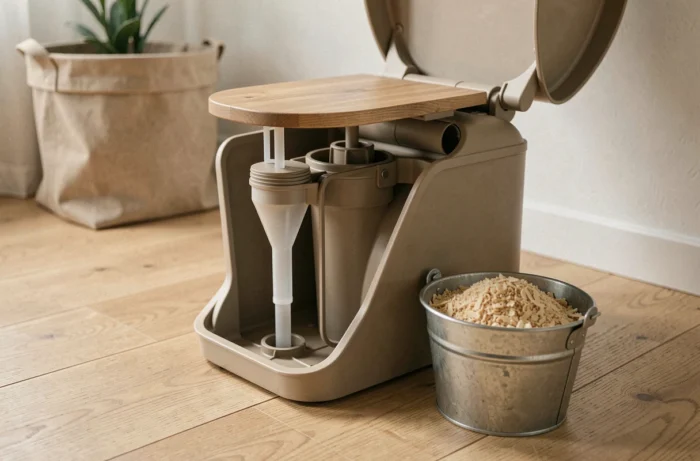
An effective dry toilet relies on the separation of urine and continuous ventilation. Manufactured models incorporate a urine/feces separator and an extraction duct connected to a wall or roof outlet.
A repurposed Ikea piece of furniture does not offer any of this. Adding a bathroom fan to a hole drilled in the back panel works, but the cut weakens the structure, and the absence of a separator requires systematic coverage with sawdust after each use, with larger quantities needed to absorb moisture.
Manufactured dry toilets or Ikea assembly: realistic choice criteria
The question of the “Ikea choice” actually hides a trade-off between initial budget and the durability of the installation. Here are the parameters to weigh:
- Longevity: a particle board piece of furniture rarely lasts more than two years in daily dry toilet use, compared to several years for a solid wood or recycled plastic unit designed for this use.
- Urine separation: manufactured models offer an integrated separator that significantly reduces odors and facilitates composting. For a homemade setup, a separator must be purchased separately and adapted to the cut of the top plate.
- Regulatory compliance: a specialized manufacturer provides an installation manual that complies with non-collective sanitation requirements. A DIY setup offers no guarantee in case of SPANC (Public Service of Non-Collective Sanitation) inspection.
- Aesthetics and social acceptability: for a primary residence occupied year-round, the “modified storage furniture” aspect may pose an acceptance issue for other household members.
Water savings and dry toilets in homes: available data
The water consumption related to toilets represents a significant part of daily domestic use. Completely eliminating flush toilets with dry toilets mechanically reduces this consumption, a central argument for households engaged in a sustainable approach.
The available data do not allow for precise quantification of the savings achieved by an average French household, as it depends on the number of occupants, the type of flush (single or dual flush), and the frequency of use. The water savings are real but vary according to each configuration.
The decree of July 29, 2026, applicable since August 15, 2026, experimentally expands certain uses of gray water until December 31, 2034. For a household equipped with dry toilets, this evolution does not have a direct impact on the toilets themselves, but it opens the possibility of reusing shower or sink water for irrigation, complementing the overall logic of reducing drinking water consumption.
Composting waste: the real technical issue
Installing a dry toilet without mastering the downstream process amounts to shifting the problem. Composting waste from dry toilets requires:
- A dedicated compost bin, distinct from kitchen or garden compost, with a sufficient temperature rise to eliminate pathogens.
- A long maturation period (field feedback generally mentions one to two years before spreading).
- Sufficient outdoor space, which effectively excludes apartments and some townhouses without gardens.
Without controlled composting, a dry toilet loses its ecological justification. Non-composted waste ends up in household garbage, negating the environmental benefit and posing a health problem.
The assembly from Ikea furniture does not change this requirement. The structure of the furniture does not affect the quality of composting, but households attracted by the ease of the DIY hack sometimes underestimate the long-term management constraints of the waste. Before cutting a piece of furniture, the first question to ask remains that of the available space and composting method.