
For several years, the leisure golf market has seen the emergence of balls equipped with GPS or RFID chips capable of transmitting real-time data. These connected balls promise to locate each shot, measure the distance traveled, and provide detailed game statistics on a smartphone.
The concept appeals to manufacturers and driving range operators, but it faces a strict regulatory framework that currently limits its use to training and leisure play.
USGA and R&A Compliance: Why GPS Balls Remain Banned in Competition
The rules of the USGA and R&A require that a golf ball be “traditionally constructed” and contain no communication or measurement device integrated during play. GPS balls are not compliant for official tournaments.
This restriction is not a mere administrative detail. It conditions the commercial positioning of these products. A golfer who trains with a connected ball and competes with a traditional ball must deal with potentially different sensations of impact and two distinct aerodynamic behaviors. The question of the transferability of training data to actual play remains open.
For casual players or leisure golfers who never participate in sanctioned competitions, the constraint disappears. It is indeed in this segment that manufacturers are focusing their efforts, betting on the idea that an innovative GPS golf ball transforms recreational play into an analytical experience.
Embedded Technologies: RFID, Bluetooth, and GPS in a Golf Ball
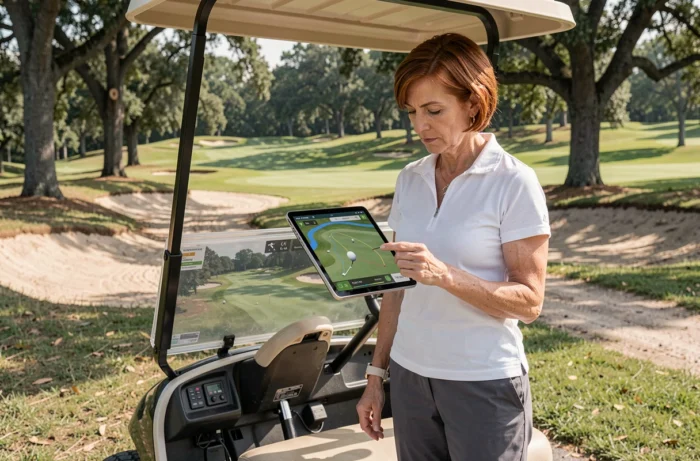
Three technologies coexist in the market, and they do not provide the same data.
- RFID (Radio Frequency Identification) uses passive tags that communicate with base stations installed on the course or practice area. It mainly allows for ball location and shot counting but relies entirely on the course’s infrastructure.
- Low Energy Bluetooth (BLE) transmits data to a mobile device within a limited range. It is mainly used for simulators and indoor environments, where the distance between the ball and the sensor remains small.
- Integrated GPS offers autonomous geolocation, without ground infrastructure. It is the most ambitious technology, but also the most constrained by chip size, battery life, and the regulatory weight of the ball.
The battery life remains the main bottleneck. A golf ball experiences violent accelerations upon impact, which puts significant stress on the miniaturized components. Few independent tests have been published on the actual longevity under intensive play conditions.
Connected Driving Ranges: The Real Playground for GPS Balls
The most visible adoption of these technologies is not on the courses but in driving ranges. The Bethpage complex in the United States reported a notable increase in its attendance after the installation of the InRange system, which combines traceable balls and real-time data screens at each hitting station.
Driving range operators see the connected ball as a loyalty lever. The golfer no longer comes to hit a bucket of anonymous balls: they track their progress, compare their sessions, and share their statistics. The business model shifts from selling buckets to selling an experience of data-assisted coaching.
For golf coaches, the interest is direct. The launch data (launch angle, ball speed, spin) collected by the ball or associated radars allow for a more objective diagnosis of the swing. This data does not replace the coach’s eye on body mechanics, posture, or grip.
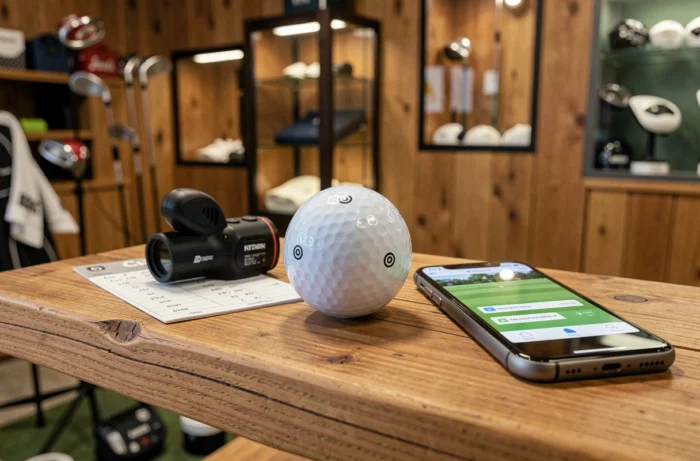
Ball Rollback and the Future of Connected Balls for Amateur Golfers
Another factor weighs on the future of these products. The USGA and R&A have been working for several years on a revision of the ball distance rules (the “ball rollback”), the general implementation of which has been postponed to at least 2030. The governing bodies are considering a bifurcation of the rules between professionals and amateurs.
This bifurcation could open a favorable space for GPS balls in leisure golf. If amateurs are no longer subject to the same distance and performance standards as professionals, manufacturers would have more latitude to integrate electronic components without worrying about competition specifications.
The tension between connected innovation and regulatory limitations on distance is not yet resolved. The amateur market could become a free experimentation ground for smart balls, while the professional circuit remains locked by strict standards.
Concrete Limitations to Consider Before Investing in a Connected Ball
Before being swayed by marketing promises, several points deserve attention.
- Compatibility with launch radars is not universal. Each model of connected ball works with a limited list of launch monitors, and software updates condition the proper functioning of tracking.
- The weight and balancing of a ball equipped with a chip may differ from a traditional ball. The impact on flight and spin remains to be documented by independent tests.
- Dependence on a mobile application and network connection adds a layer of complexity. A dead phone battery at hole 14 renders the GPS ball silent.
- The unit cost of these balls far exceeds that of a traditional premium ball, raising questions about value for a golfer who loses several per round.
The connected golf ball undeniably transforms the experience at the driving range and in leisure play. On the competitive course, it remains a technological curiosity without permission for use. The regulatory decisions expected by 2030, particularly regarding the bifurcation of rules between pros and amateurs, will directly impact the place these balls can occupy in the everyday equipment of leisure golfers.