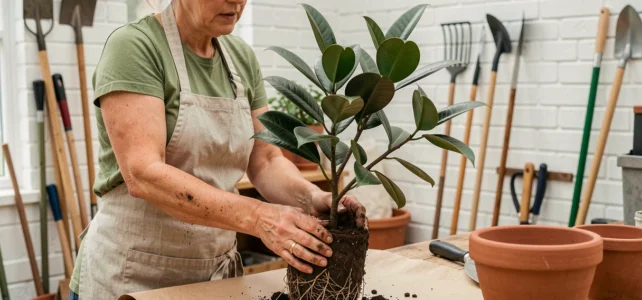
The ficus benjamina reacts to repotting as if it were a brutal move: it loses its leaves. This leaf drop, common in the days that follow, leads many owners to postpone the operation or to multiply inappropriate care. The problem does not come from the repotting itself, but from what happens before, during, and especially after.
Ficus benjamina substrate: universal potting soil is not enough
Most guides recommend a “good potting soil” without specifying what that means for a ficus. The universal potting soil sold in garden centers retains too much water and compacts within a few months. The roots of the benjamina, fine and sensitive, end up submerged in an asphyxiating substrate.
Recent specialized sources highlight the importance of an airy and structured substrate rather than just simple potting soil. The principle: mix potting soil with perlite, composted pine bark, or pumice to ensure quick drainage. Water should pass through the pot in a few seconds, not stagnate on the surface.
A substrate that is too compact causes exactly the same symptoms as overwatering: yellowing leaves, gradual drop, soft roots. Preparing the right mix before repotting avoids the majority of post-repotting problems. When approaching the repotting of the ficus benjamina step by step, the choice of substrate is the most decisive decision.
Repotting the ficus: when and how to proceed without root stress
Spring remains the safest time. The ficus then enters a phase of active growth, allowing it to quickly colonize the new substrate. Repotting in autumn or winter, when the plant slows down, increases the risk of root rot since the roots absorb almost no water.
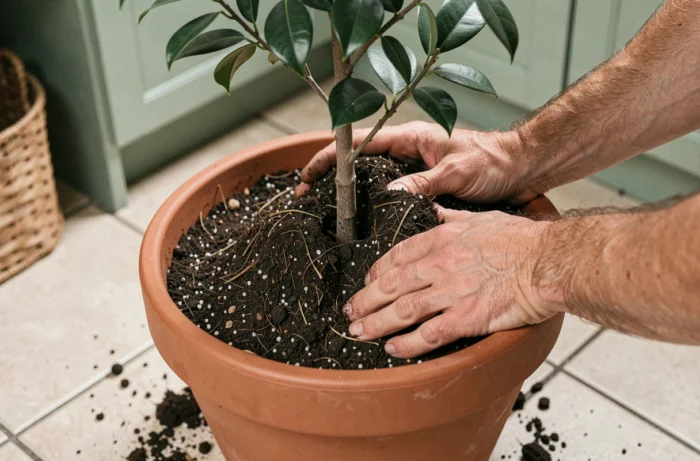
Choosing the pot size
A pot that is too large is a common mistake. The excess potting soil remains wet for too long, creating an environment conducive to root asphyxiation. The new container should only exceed the old one by a few centimeters in diameter.
Handling the roots without excess
Gently untangling the peripheral roots is sufficient in most cases. Cutting dead or black roots (a sign of rot) is justified, but massively pruning the root system of a healthy benjamina causes unnecessary stress. The plant reacts to any root disturbance by sacrificing foliage.
- Ensure that the pot has functional drainage holes, not just decorative ones
- Place a layer of clay balls or gravel at the bottom to facilitate water drainage
- Do not compact the substrate around the roots: fill, then let watering naturally settle the soil
- Water moderately just after repotting, without drowning the root ball
Watering after repotting: the overwatering trap
The most common reflex after repotting is to water generously to “help the plant settle in.” It is precisely the opposite that should be done. Overwatering is more dangerous than temporary dryness in the days following the operation.
Recent recommendations converge on one point: wait until the top two to three centimeters of the substrate have dried before resuming watering. Standing water in the tray or saucer should be systematically emptied to avoid root asphyxiation.
A ficus that has just been repotted has a disturbed root system. Its absorption capacity is temporarily reduced. Excess moisture promotes fungi and accelerates the decomposition of roots damaged during handling. A slightly dry substrate forces the roots to explore their new environment.
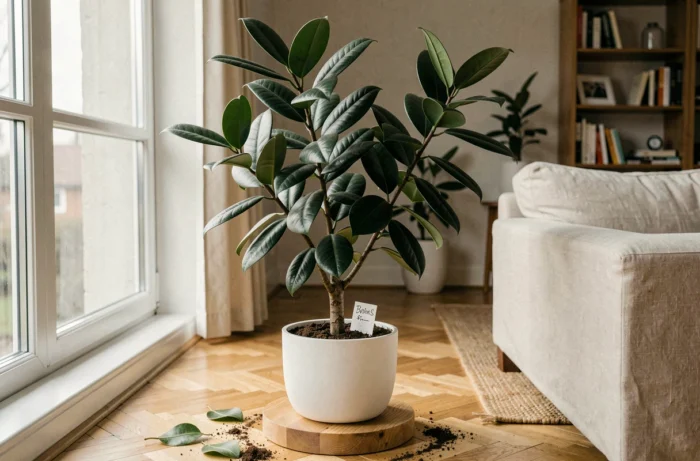
Leaf drop of the ficus after repotting: distinguishing normal from problematic
Leaf loss in the days following repotting is documented as a common phenomenon. A temporary drop lasting one to two weeks does not mean the plant is lost, provided that environmental conditions remain stable.
The distinction between a temporary stress reaction and a real problem relies on a few simple observations.
- The falling leaves are green and firm: this is likely mechanical stress or a change in environment. The plant is adapting.
- The leaves yellow before falling: excess water or poorly drained substrate is the primary suspect.
- The leaves brown at the edges, dry out: lack of ambient humidity or direct sun exposure after repotting.
- The drop continues beyond three weeks with foliage that does not renew: a deeper root problem (rot, pests) deserves an examination of the root ball.
The recovery time varies from specimen to specimen. Some ficus recover in a few days, others take several weeks. The speed of recovery depends on the state of the roots at the time of repotting and the stability of conditions after the operation.
Do not move the ficus after repotting: an underestimated factor
The benjamina hates changes in position. Light, temperature, drafts: any modification of its environment triggers a defense reaction that results in leaf drop. Repotting and moving at the same time combines two sources of stress.
The most protective reflex after repotting is to place the plant back in exactly the same spot. If the ficus received a certain amount of light before the operation, it should regain the same exposure. Even rotating the pot can be enough to disturb a sensitive benjamina.
A ficus placed in a bright location (without direct sunlight), sheltered from drafts and temperature variations, tolerates the shock of repotting much better. The stability of the environment is as important as the quality of the substrate to limit leaf loss.
Repotting a ficus benjamina is not technically complex. What makes the difference is the management of the aftermath: measured watering, a draining substrate, and a plant that returns to its place without moving. Renewed foliage generally appears as soon as the substrate, watering, and location are stabilized.