
You receive an invoice from Markeonbiz.fr for your marketing AI tools, and right from the second line, the technical vocabulary muddles the reading. Subscription, add-ons, processing fees, compliance costs: each item seems to refer to a different logic. Analyzing these AI rates requires a simple method, applicable line by line, to identify what you are really paying for and what remains unclear.
Hidden costs of e-invoicing compliance 2026 on an AI invoice
Before even looking at the price of a subscription, one question arises: does the invoice you receive comply with the new regulatory framework? Since September 1, 2026, all companies must be able to receive electronic invoices in a structured format compliant with standardized profiles such as EN16931 or the Factur-X, UBL, and CII formats.
This framework was specified by the decree of July 27, 2026, and the associated order, published in the Official Journal on July 28, 2026. Check if your invoice mentions the structured format used. A simple PDF invoice, without data that can be processed by accounting software, is no longer compliant for receipt since September 2026.
On a Markeonbiz.fr invoice, look for a line that refers to the connection to an approved partner dematerialization platform (PDP) or the public invoicing portal. If this line exists, it represents a real interoperability cost. If it is absent, ask the question: who is responsible for transmission to the approved platforms, and at what cost?
To understand Markeonbiz.fr invoices and their AI pricing, you need to isolate these compliance costs from the displayed price of the AI tool itself.

Markeonbiz.fr AI rates: reading each line of the invoice without jargon
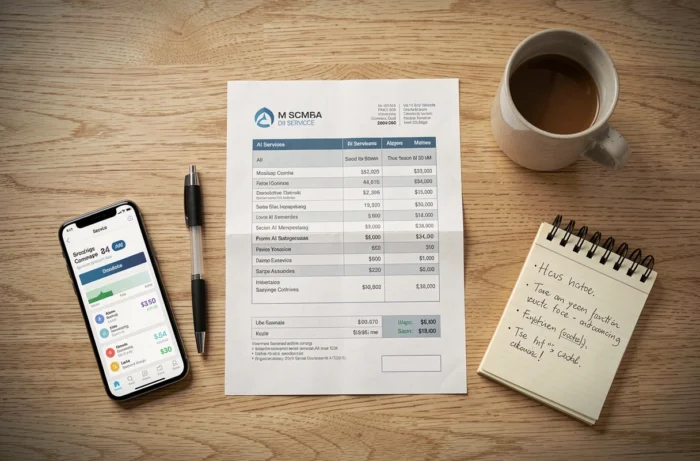
Let’s take a concrete example. You open your invoice and see three distinct blocks: a monthly subscription, usage-based processing fees, and options. Each block follows its own pricing logic.
The basic subscription
This is the foundation. It covers access to artificial intelligence tools (content generation, campaign management, customer data analysis). The fixed subscription does not vary based on your usage volume. If your invoice shows a different amount from one month to the next on this line, it means a change in the plan has been applied, whether intentionally or not.
Variable fees related to volume
Some features are billed based on usage: number of campaigns launched, volume of customer data analyzed, amount of content generated. These lines often carry technical titles (tokens, API credits, processing calls).
Have you noticed that the same service can appear under two different lines? This is common when an AI module uses several technical components in the background. Add up all the variable lines to get your actual usage cost, then compare it to the base package. If the variable portion exceeds half of the total, a higher package might be more economical.
Options and add-ons
Advanced VAT management, connectors to third-party accounting software, e-reporting functions: these options appear as separate lines. They are sometimes activated by default during a platform update.
- Check each active option in your client area and compare with the billed lines: an unused but billed option is an avoidable cost.
- Identify lines related to regulatory compliance (e-invoicing, e-reporting, PDP connection): they are not optional if your company falls within the 2026-2027 timeline.
- Identify update or maintenance fees: they may be included in the subscription or billed separately depending on the chosen plan.
Risks of e-invoicing non-compliance and impact on the AI budget
Focusing solely on the displayed price of an AI tool means ignoring a potentially heavier expense item: the cost of non-compliance with the electronic invoicing reform.
Since September 2026, large companies and mid-sized enterprises must issue their invoices in the mandatory electronic circuit. SMEs and micro-enterprises have until September 1, 2027, to issue invoices, but receipt is already mandatory for all. The decree of July 27, 2026, confirmed this timeline and specified the minimum technical specifications.
Why does this timeline concern your Markeonbiz.fr invoice? Because if the AI tool you are using generates invoices for your own clients, these documents must comply with the imposed structured formats (Factur-X, UBL, or CII as applicable). A tool that only produces unstructured PDFs exposes you to manual reprocessing or even rejection by your client’s platform.
Three concrete checks protect your budget:
- Ask Markeonbiz.fr if the invoices generated by their tools are compatible with the EXTENDED-CTC-FR profile or an EN16931 profile recognized by the French tax administration.
- Check that the platform is connected to at least one approved PDP or the public invoicing portal, and that this connection is included in your subscription or billed transparently.
- Ensure that e-reporting data (transmission of transaction data to the administration) is handled automatically. A failure to report e-reporting is not without tax consequences.
Quick reference grid to compare AI rates
Beyond Markeonbiz.fr, this method applies to any AI offer aimed at businesses. The displayed price is never the complete cost of an AI tool in 2026.
| Item to check | Where to find it on the invoice | Question to ask |
|---|---|---|
| Fixed subscription | First line, recurring amount | Does this amount include regulatory updates? |
| Variable fees (tokens, credits) | Lines detailed by module | What is the cap before overbilling? |
| e-invoicing compliance | PDP line, connection, e-reporting | Is the connection included or billed separately? |
| VAT and mandatory mentions | Invoice footer | Does the invoice comply with the imposed structured format? |
Reviewing an AI invoice with these four markers takes just a few minutes. The gain is twofold: you control your actual budget and anticipate the tax obligations that already apply or will apply starting September 2027 for smaller structures. A sole proprietor as well as a mid-sized enterprise should demand this transparency from the next invoice.