Getting a perfectly straight cut over several linear meters of hedge is not just a matter of eye. The consistency of the result depends on measurable parameters: blade inclination, guide tension, trimming frequency, and the geometric shape given to the shrub. Before taking out the hedge trimmer, it is useful to understand what distinguishes a clean cut from a rough one, and why certain technical errors lead to gradual thinning at the base.
Trapezoidal or rectangular shape: impact on foliage density
Most guides recommend a straight vertical cut. This is the most intuitive shape, but it presents a concrete problem: the branches at the top end up shading the base, which thins out in just a few seasons.
The slightly inward-leaning conical shape at the top ensures that light reaches the base of the hedge. The table below compares the two geometries according to three practical criteria.
| Criterion | Rectangular cut (vertical) | Trapezoidal cut (inclined) |
|---|---|---|
| Brightness at the base | Low after two to three years | Maintained over time |
| Risk of thinning at the base | High, especially for evergreens | Very low |
| Difficulty of trimming | Less technical | Requires a reliable inclination reference |
| Visual result | Strict line, formal appearance | Clean line with a slight natural flare |
For hedges of thuja, laurels, or hornbeams, the trapezoidal cut is the one that best preserves density throughout the height. The angle does not need to be pronounced: a few degrees are enough to change the light distribution.
If you are looking to properly trim a straight hedge, the first decision is therefore about the target geometry, not the choice of tool.
String line technique for trimming a hedge: precision of the gesture
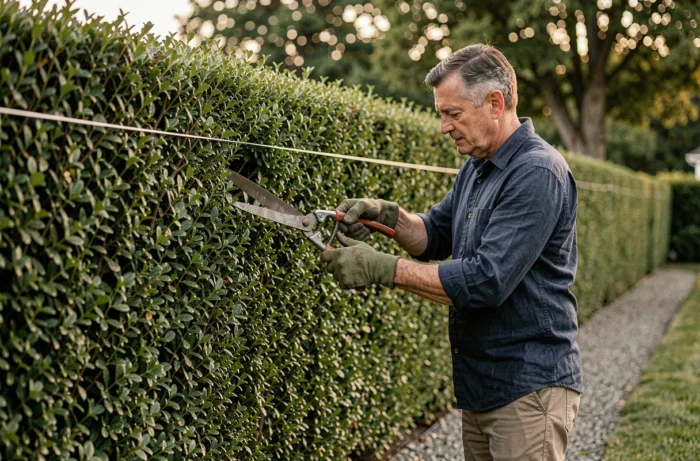
The string line stretched between two stakes remains the most reliable method for maintaining a regular cutting line. The string serves as a permanent visual reference and avoids successive corrections that create dips in the foliage.
Setting up the cutting guide
- Plant a rigid stake at each end of the hedge, driven in deep enough not to move during trimming. A level placed against the stake ensures its verticality.
- Stretch a non-stretchable string (braided cotton or polypropylene) at the desired cutting height. Use a bright color, red or yellow, so that the string remains visible against the green foliage.
- Do not overly tighten the string: moderate tension prevents the stakes from leaning inward and distorting the reference.
The string line is set before each pass, including for the sides. For the lateral face, the string is fixed at two different heights if you adopt the trapezoidal shape, which materializes the inclination.
Direction and amplitude of the cutting motion
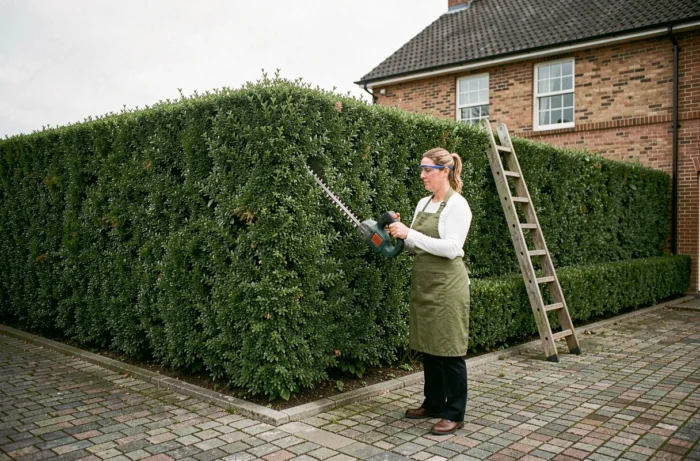
The hedge trimmer moves in an arc, from bottom to top for the sides. This upward motion allows debris to fall as you go and avoids going over piles of cut leaves that obscure the line.
For the top, the motion is horizontal, moving the blade away from oneself. The length of the blade itself serves as a visual guide: a blade of fifty centimeters or more allows for smoothing out irregularities over a sufficient width with each pass.
Hedge trimming period and nesting constraints
The trimming schedule affects both the aesthetic result and regulatory compliance. Fast-growing shrubs (privets, laurels, hornbeams) require two passes per year to maintain a neat profile. Slow-growing evergreens (yews, boxwoods) only need one annual trim.
The period from mid-March to the end of July corresponds to the nesting of many bird species. There is no single national prohibition applicable to all individuals, but local regulations may restrict trimming during this window. Farmers subject to CAP subsidies face stricter restrictions.
In practice, checking for the presence of nests before any intervention remains the most direct precaution. An active nest in the hedge makes trimming illegal under species protection laws, regardless of the time of year.
Maintenance of the hedge trimmer and cutting quality
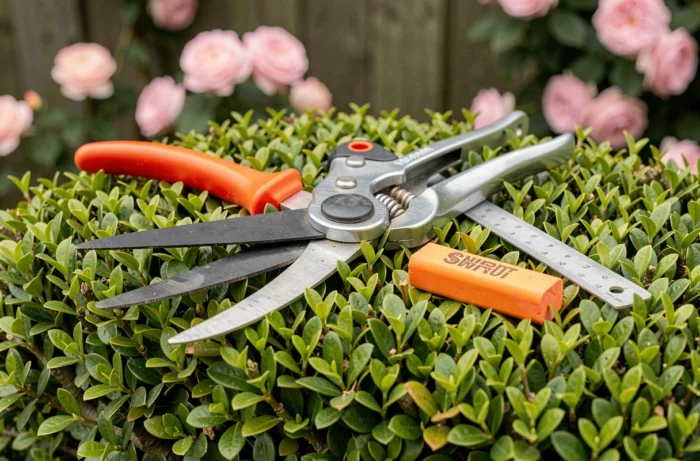
A dull blade does not cut: it crushes branches. Torn plant tissues turn brown within days and give the hedge a dried-out appearance, even on healthy shrubs.
Sharpening and disinfecting the blades after each trimming session protects both the sharpness of the cut and the health of the plants. Disinfection with alcohol limits the spread of fungal diseases from one shrub to another.
The weight of the device also affects the regularity of the gesture. A hedge trimmer that is too heavy tires the arms and causes oscillations that result in waves in the cutting line. Recent cordless models offer a good compromise between power and lightness for residential garden hedges.
Trimming mistakes that thin a hedge in just a few seasons
Three mistakes consistently occur among amateur gardeners and produce visible damage as early as the second year.
- Cutting too short in one go. Removing more than one-third of the leaf mass in a single pass stresses the shrub. Replacement shoots take several months to cover the bare areas.
- Neglecting the base. Only trimming the top and upper sides accelerates thinning at the base, especially with rectangular cuts.
- Trimming in hot or dry weather. Cuts expose fresh plant surfaces that dehydrate quickly. Favoring a cloudy day or cooler hours reduces post-trimming water stress.
Regularity outweighs intensity. Two moderate trims per year maintain a dense and straight hedge much better than a single severe cut at the end of summer. Each light pass stimulates lateral branching, which thickens the foliage instead of forcing it to regrow from bare wood.