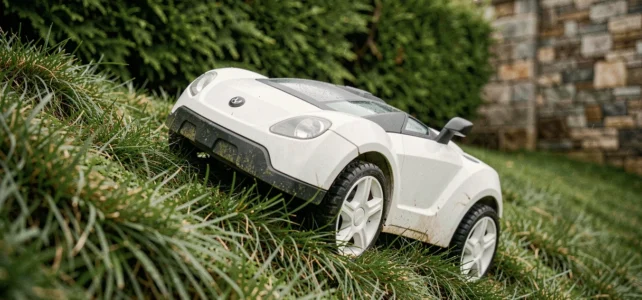
On a sloped terrain, the decisive criterion is not the maximum slope displayed on the technical sheet. It is the ability of the robotic mower to maintain a stable trajectory along the edge of the area, where the ground changes texture, where the grass stays wet longer, and where the wheels lose their grip. We regularly observe machines that can climb a regular and dry slope but are unable to navigate along a soggy bank without veering off.
Edge grip and wet ground: the true limiting factor for a robotic mower on a slope
The slope announced by a manufacturer almost always corresponds to a straight ascent on dry, dense grass. In real conditions, the most critical part is located at the edge of the mowing area, where the robot must turn or follow a boundary on ground that may be loose, mossy, or waterlogged after rain.
A 2WD (two-wheel drive) robot with standard treads holds well on a moderate and regular slope. As soon as the terrain presents a lateral slope combined with moisture, slipping becomes systematic. The robot recalculates its trajectory, loses time, and ultimately leaves uncut strips along the edges.
Choosing a robot mower for sloped terrain therefore requires checking not the maximum uphill slope but the machine’s ability to work on a slope in wet ground. We recommend measuring the incline at the most unfavorable points in the garden (with a smartphone inclinometer), especially near flower beds, hedges, and shaded areas that dry slowly.
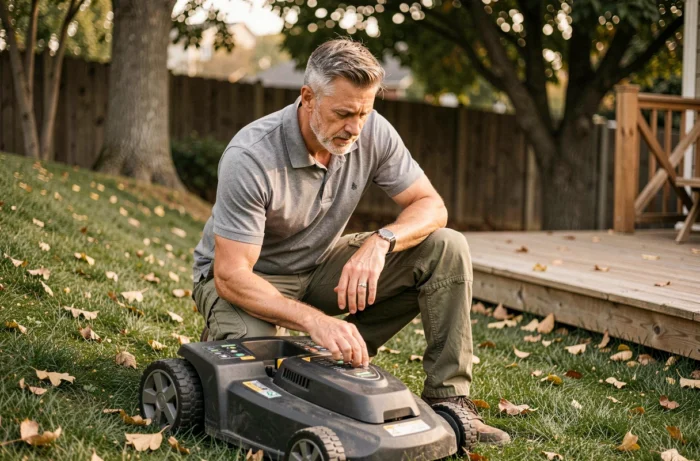
4WD or 2WD: when the transmission makes a difference
Four-wheel drive (AWD or 4WD) models are not always justified. Their higher cost and energy consumption only make sense if the terrain combines several constraints: significant slope, clayey or regularly waterlogged soil, and narrow paths on a slope.
On sloped but well-drained grass, a good 2WD with wide treads is sufficient. However, wet clay soil makes 4WD almost necessary, even on a slope that the technical sheet for the 2WD theoretically covers.
Wireless peripheral robotic mower and RTK navigation on sloped terrain
Wireless robotic mowers are rapidly advancing in complex gardens, including sloped ones. RTK, LiDAR, or onboard vision guidance eliminates the constraint of burying a wire along each edge, which is a concrete advantage on uneven terrain where the cable can easily shift or break.
On a slope, wireless navigation offers an additional benefit: the robot can adapt its trajectory in real time rather than following a random path bounded by a magnetic signal. Some RTK models plan parallel passes perpendicular to the slope, which reduces lateral slipping and improves cutting consistency.
Concrete limits of wireless navigation on slopes
RTK relies on a GNSS signal corrected by a base station. In a sunken garden bordered by large trees or buildings, accuracy decreases. The robot may then encroach on a flower bed or exit the mowing area, posing a safety issue on an overhanging slope.
LiDAR and camera vision partially compensate for these signal losses, but their reliability varies depending on vegetation density and lighting. We observe that models combining RTK and onboard vision currently offer the best compromise on sloped and partially shaded terrain.
- RTK alone: centimeter-level accuracy in open terrain, degradation under dense tree cover
- Onboard LiDAR: works in low light conditions but is sensitive to tall grass at the edges
- Camera vision: effective complement to RTK for obstacle detection, limited by rain or dew on the lens
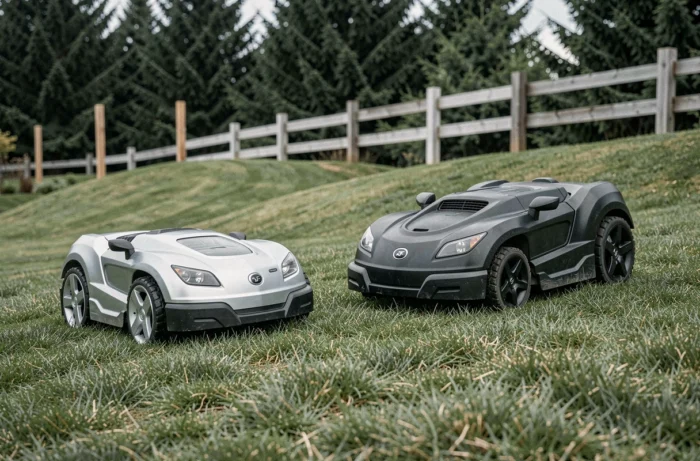
Safety of robotic mowers on slopes: children, pets, and emergency stop
A robotic mower operating on a slope presents a risk of tipping or sliding that flat terrain models do not have. Active safety becomes a priority selection criterion as soon as children or pets frequent the garden.
Recent models incorporate lift and tilt sensors that instantly cut the blades if the chassis tilts beyond a predefined angle. This function is not a gimmick: on a slope, a robot that slips with locked wheels can gain speed and reach a child or pet below.
What the technical sheet does not always mention
Check for the presence of these devices before purchase:
- Blade stop in case of chassis lift (tilt sensor), not just in case of complete overturning
- Ultrasonic or camera detection of moving obstacles (children, pets) with early stop, not just by contact with the bumper
- PIN code or app lock to prevent a child from restarting mowing
- Scheduling options to restrict mowing to times when the garden is unoccupied
A collision sensor by bumper alone is not sufficient on sloped terrain, because the sliding speed downhill reduces reaction time. Models equipped with remote detection (ultrasonic or camera) offer a significantly higher safety margin.
Technical criteria to check before buying a robotic mower for slopes
Rather than a list of models that changes each season, we recommend focusing the analysis on four parameters rarely crossed in consumer comparisons.
The width and profile of the wheels determine the contact surface with the ground. Wide wheels with deep treads on a lightweight robot provide a better grip-to-weight ratio than a heavy robot on narrow wheels.
The weight of the robot plays an ambivalent role. A heavier chassis better presses the wheels to the ground when climbing, but increases inertia when descending and further digs into soft ground. On clayey terrain, a lightweight robot with 4WD transmission often outperforms a heavy 2WD model.
The battery capacity determines the actual autonomy on slopes. A robot consumes significantly more energy when climbing than on flat ground. If the charging station is placed at the bottom of the slope, the robot must still climb back up to resume mowing after each recharge, further reducing effective autonomy.
The position of the charging station should be considered from the outset. On sloped terrain, placing the base at the top of the slope or on an intermediate flat area prevents the robot from consuming energy unnecessarily to reach its working area. This placement detail has more impact on actual performance than the difference in capacity between two battery models.