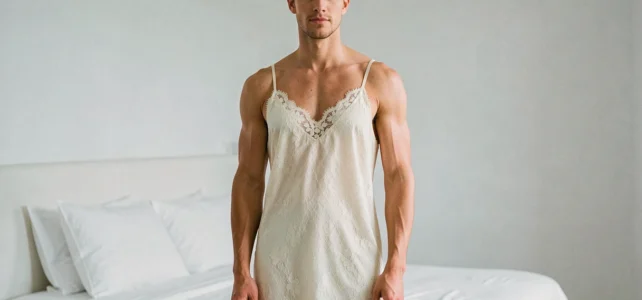
The lace nightie for men is not a niche phenomenon confined to specialized sections. Since 2024, the segment of so-called “sexy” men’s lingerie, particularly lace pieces, has shown significant growth, far exceeding that of the overall men’s underwear market, which remains almost stagnant. This disparity between a sluggish global market and a rapidly expanding sub-segment deserves attention.
Men’s Lace and Gender-Neutral Fashion: A Structural Shift
The rise of men’s lace nightwear cannot be understood without the broader context of gender-neutral fashion. Recent market reports on this segment show sustained growth, largely driven by Generation Z consumers in Europe and North America.
Brands are gradually repositioning certain lace lingerie pieces as “for all genders” rather than exclusively feminine items. This inclusivity logic is changing the traditional segmentation of catalogs. We now find nighties, bodysuits, and lace camisoles in collections labeled “unisex” or “genderless.”
This shift is not just a marketing argument. It comes with concrete adaptations: tailored cuts for male body types, choices of thicker lace or geometric patterns that move away from classic floral codes, and expanded sizes. The men’s nightie is no longer borrowed from the women’s wardrobe, but a product designed with its own cutting and fabric constraints.
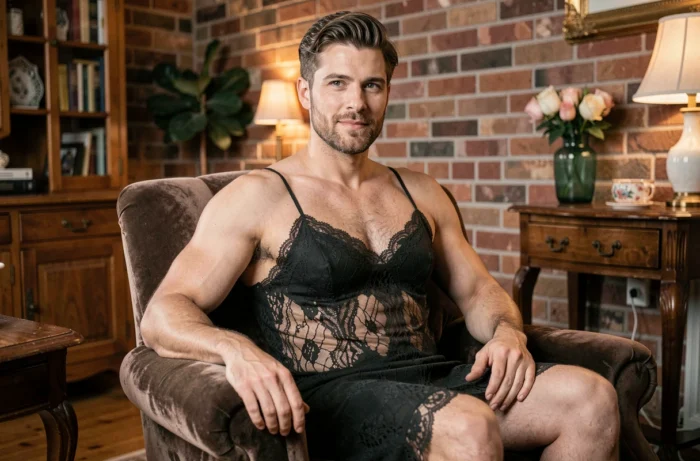
Materials and Cuts: What Distinguishes a Men’s Nightie from a Repositioned Model
A point rarely addressed in existing content concerns the technical difference between a men’s nightie designed as such and a women’s model simply offered in larger sizes. The distinction is far from trivial.
Technical Criteria to Check
- Shoulder width and armhole: a nightie designed for a man has a wider shoulder passage, without straps that compress the trapezius. Repositioned models often retain unsuitable thin straps
- The choice of lace: men’s collections favor nylon or cotton-elastane blend laces, which are more resistant to pulling, whereas fine Calais lace is reserved for high-end women’s pieces
- The lining at the torso: most men’s nighties include an opaque fabric panel (satin, cotton, or microfiber) at the front, which alters the drape and comfort when worn
- Length: men’s models often stop mid-thigh, with a straight or slightly flared cut, while women’s models play more on asymmetry
These technical details explain the price gap sometimes observed between a low-end “unisex” nightie and a piece specifically designed for a male silhouette.
Advertising Regulation and Representation: A Still Unclear Framework
Advertising for men’s lace lingerie faces an ethical framework that has not been designed for this type of product. In France, the ARPP (Professional Advertising Regulatory Authority) governs representations of the body in advertising, but its recommendations do not specifically address men’s lingerie.
Brands wishing to promote men’s lace nighties navigate several constraints. Advertising platforms (Meta, Google Ads) apply strict rules on content showing lingerie, without always distinguishing between male and female visuals. Some brands report campaign rejections for visuals of men in lace deemed “adult content,” while equivalent female visuals pass moderation.
Field feedback varies on this point. Some online retailers encounter no issues, while others must systematically adapt their visuals for paid distribution. The lack of a clear framework creates unequal treatment that hinders the visibility of these collections.
Online Sales and Fitting: The Main Barrier to Purchase
Almost all sales of men’s lace nighties occur online. Physical stores, including those specializing in men’s lingerie, still allocate very little space to this type of item. This reality poses a concrete problem: fitting.
Lace is a fabric that reacts differently depending on body type. The same model in size M can fall very differently on two people with the same chest measurement but distinct builds. The size guides offered by sales sites often mirror those of classic underwear (briefs, boxers), which do not take into account torso length or back width.
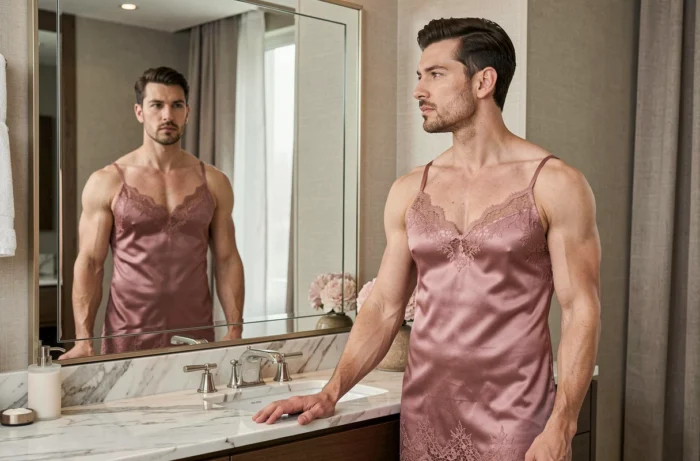
Some brands are beginning to offer more precise sizing tools, with additional measurements (chest circumference under the arms, shoulder-hip length). However, return policies vary greatly from site to site, and some retailers exclude lace lingerie from returns for hygiene reasons, complicating the process of a first purchase.
Men’s Lace: A Still Fragmented Market
The market for men’s lace nighties lacks a central aggregator. Buyers navigate between specialized brands (Addicted, HOM, Lookme), generalist marketplaces (Amazon, where sorting remains laborious), and LGBTQIA+ boutiques that offer more targeted selections. Each channel has its advantages and limitations.
Specialized brands generally offer better size and material tracking, but with limited collections. Marketplaces provide a wider choice, at the cost of very uneven quality and sometimes vague product descriptions. The fabric labeled as “lace” can refer to either woven lace or simple openwork tulle, which radically changes the look and durability.
The rapid growth of the segment also attracts opportunistic sellers, with very low-priced products made from low-quality synthetic materials. Checking the exact fabric composition (percentage of nylon, presence of elastane, type of lace) remains the most reliable reflex before any purchase, much more than product photos that do not accurately reflect the drape on a male body.