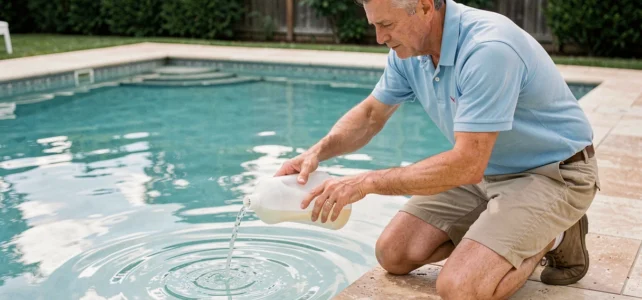
The water in the pool remains cloudy after a shock chlorine treatment, and the bottom appears blurry despite filtration running for hours. Clarifier is added, then chlorine, then more clarifier, and the problem worsens. This scenario recurs every summer in pool forums, and the cause is almost always the same: a wrong order of use between chlorine and clarifier, not a bad product.
False zero on the chlorine test: the trap of adding clarifier too soon
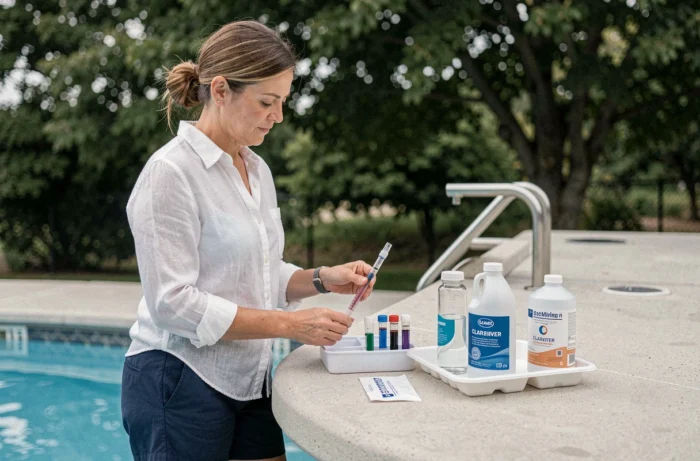
When clarifier is poured in the hours following a shock chlorine treatment, test strips or DPD reagents can give an aberrant reading. Documented feedback from specialized sites reports a specific phenomenon: the test shows zero while the free chlorine is actually out of measurement range.
The consequence is direct. One thinks that the chlorine has been consumed, adds more, and ends up with an over-chlorinated pool. The water becomes irritating, the clarifier loses effectiveness as the pH drifts, and one enters a cycle of overdose that is hard to break.
To avoid this situation, note the exact time of each addition, the product used, and the dose. Before knowing how to use clarifier with chlorine without creating a chemical conflict, one must accept a simple principle: do not mix the steps, space them out.
Order of chlorine and clarifier treatment for pools: the sequence that works
Most merchant guides describe what clarifier does but quickly gloss over the order in which to intervene. Yet this is where everything is decided. Here is the sequence applied in practice when the water is cloudy.
- First, check the pH and bring it back into the correct range (between 7.2 and 7.4 for chlorine treatment). As long as the pH is not stable, any added product works poorly.
- Next, perform the chlorine treatment (shock or corrective depending on severity). Filtration runs continuously during this phase, and we wait for the free chlorine level to drop to a measurable level before moving on to the next step.
- The clarifier is only introduced last, once disinfection is complete and chlorine has returned to its normal range. Its role is to finish the job by agglomerating the microparticles that the filter does not capture alone.
Skipping a step or reversing the order amounts to masking a structural problem (unstable pH, ineffective disinfectant) under a layer of cosmetic product. The clarifier does not correct anything; it improves the clarity of already healthy water.
Pool clarifier and filtration: why the filter decides everything
The clarifier agglomerates fine particles into larger clumps. These clumps must then be captured by the filter. If the filter is clogged, undersized, or unsuitable, the clarifier is useless.
With a cartridge filter, the clarifier is the logical choice. The filtration fineness of a cartridge is better than that of a sand filter, and the agglomerates created by the clarifier are large enough to be retained. The flocculant, on the other hand, produces heavier clumps that sink to the bottom, which is better suited for sand filters where the deposit can be vacuumed.
Check the condition of the filter before adding anything. A backwash (or cartridge rinse) just before the clarifier significantly improves the result. Leaving the filtration running continuously for at least twenty-four hours after the addition allows the clarifier to do its complete job.
When the clarifier is not enough
If the water remains cloudy after two complete filtration cycles with clarifier, the problem lies elsewhere. The most common causes: a calcium level that clogs the filter media, a pump that does not circulate enough of the pool volume, or a residual disinfectant level that is too low, allowing organic matter to develop.
Feedback varies on this point, but experienced pool professionals advocate a minimalist approach: let chlorine and filtration do the bulk of the work, and only resort to clarifier as a finishing touch. Algaecides and multiple corrective products often fall more into marketing than technical necessity for regular maintenance.
Dosage of clarifier and precautions for use with chlorine
The dosage depends on the product and the volume of the pool. Each manufacturer indicates an amount on the label, and one should stick to it. Underdosing prolongs the clarification time, overdosing creates an excess of polymers that can itself cloud the water.
Here are a few concrete points to keep in mind:
- Pour the liquid clarifier directly in front of the return jets to promote dispersion. Never mix it with chlorine in the same container.
- Do not swim during the treatment phase. The waiting time varies depending on the product, but filtration must have completed at least one full cycle.
- Retest free chlorine and pH after clarification, not before. A reliable test requires sufficient time between each product addition.
Documenting each intervention (date, time, product, dose, test result) may seem tedious, but it is the only way to identify a pattern when cloudy water returns regularly. A pool logbook is worth more than yet another corrective jug.
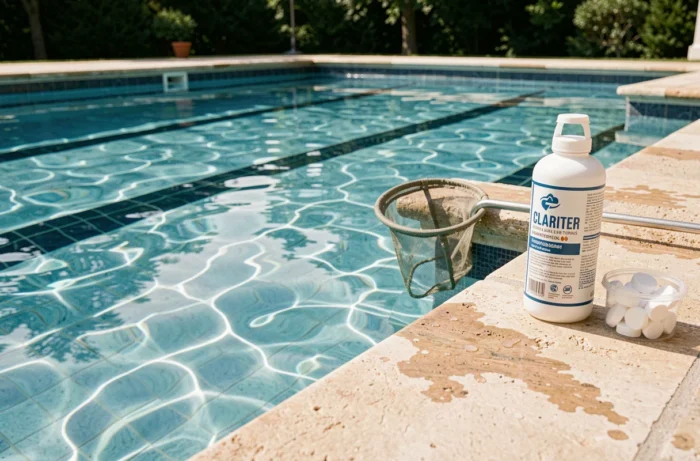
Clear pool water relies on three pillars in the correct order: chemical balance, chlorine disinfection, then clarification. The clarifier is not a universal corrector; it is a finishing tool. Respecting the sequence and spacing out additions remains the most reliable method to avoid the vicious cycle of overdosing.