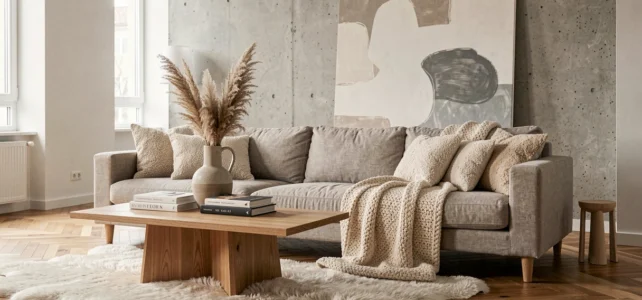
A beige sofa that tells no stories, white walls by default, a living room where everything looks the same without knowing why: we all know that moment when the interior seems frozen. Recent decor trends offer concrete ideas to break this inertia, provided you know which ones are worth applying at home and how to adapt them to a real space.
Colour drenching and enveloping walls: transforming a room without tearing everything down
Repainting an accent wall, we’ve all done it. The result is often timid: an isolated splash of color floating in a white decor. The colour drenching technique takes a completely different approach. The same shade is applied to the walls, woodwork, baseboards, and sometimes the ceiling. The effect is immediate: the room gains depth and coherence.
On the ground, it requires a bit of method. Start with a modest-sized room (a bedroom, an office) to test the effect before moving to the living room. The shades that work best are those with medium saturation: moss green, burgundy, chocolate. Feedback varies on very dark colors in small spaces, but well-placed lighting largely compensates for the perceived loss of brightness.
To find suitable color and material combinations for this type of project, one can explore specialized catalogs like https://imaginairdeco.fr/ which gathers useful references to guide your choices.
Curved shapes and sculptural furniture: how to integrate the trend without overcrowding
Straight lines and sharp angles have dominated interior decoration for years. The shift towards curved and organic shapes meets a concrete need: to soften spaces perceived as too rigid. Armchairs with rounded backs, coffee tables with irregular contours, oval or asymmetrical mirrors: these sculptural pieces are multiplying in recent collections.
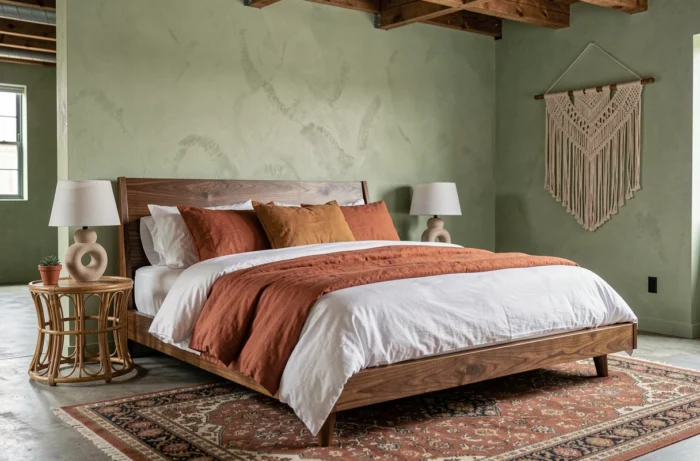
The classic trap is to accumulate. One sculptural piece is enough to change the atmosphere of a living room. If you place a generously shaped sofa, the coffee table can remain geometric. The balance between curve and straight line avoids the “showroom” effect where every object competes for attention.
Another practical point: furniture with organic shapes often takes up more floor space than one might imagine. Before buying, measure the actual footprint and check the circulation in the room. A beautiful sculptural armchair that blocks the passage to the kitchen quickly loses its charm.
Dark wood and furniture-effect kitchens: breaking away from all-white
For a good decade, the ideal kitchen was white, smooth, almost clinical. The opposite movement is underway. Medium to dark wood is returning to kitchens, with an aesthetic that resembles living room furniture rather than technical equipment. We talk about “furniture-effect kitchens”: the facades resemble a sideboard, the handles are visible, and the wood is stained walnut or smoked oak.
In practice, you don’t have to change your entire kitchen to capture this trend. Replacing the facades of a few upper cabinets with dark wood, or adding a walnut island to an existing kitchen, already creates a striking contrast with a light countertop.
This style works particularly well in open interiors. When the kitchen communicates with the living room, dark wood creates continuity with the rest of the furniture. The living space gains coherence, and the kitchen stops being a utilitarian block placed in a corner.
Bold maximalism: which pieces to decorate without restraint and which to spare
Maximalism does not mean cramming objects everywhere. It’s the return of color, pattern, and layering, after years of dominant beige. Walls filled with frames, patterned textiles, contrasting material combinations: the trend encourages bolder choices.
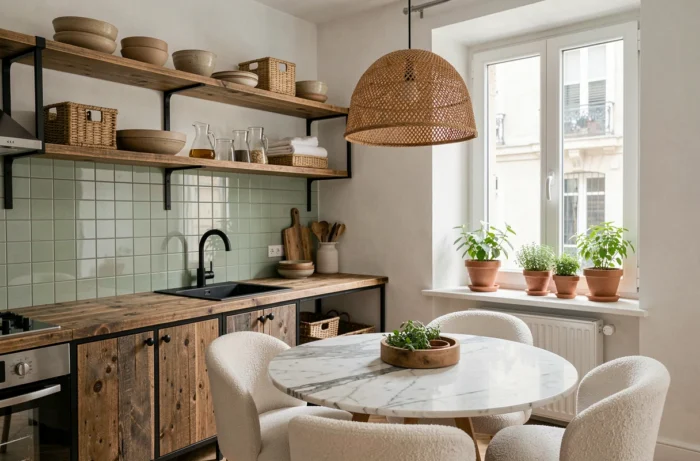
On the ground, the most common mistake is wanting to maximize everything at once. An effective approach:
- Choose a single room as a “maximalist laboratory” (the living room or bedroom, rarely both at the same time)
- Keep passage spaces (hallway, entrance) more subdued to create a contrast that highlights the main room
- Layer textures before colors: a thick wool rug on raw wood flooring, velvet cushions on a linen sofa, is already maximalism without the risk of bad taste
Successful maximalism relies on a guiding thread. Choose a palette of three or four colors and stick to it. The freedom lies in shapes, textures, and accumulations, not in an uncontrolled rainbow.
Sustainable decor trends: distinguishing fleeting fads from lasting choices
Not all trends have the same lifespan. Some belong to a short cycle (a Pantone color of the year, a viral pattern on Pinterest), while others reflect a deeper movement that will last several seasons.
- Fundamental trends: natural materials, dark woods, organic shapes, colour drenching. These directions have been establishing themselves for several years and are strengthening
- Trends to watch: the Memphis style (graphic and bold) comes back regularly and then fades away. Caution is recommended
- Fleeting fads: highly thematic decor inspired by a movie or series. Fun as accessories, risky as furniture investment
For an interior that evolves without going out of style, invest in foundational pieces (sofa, table, storage) in timeless lines, and reserve the most marked trends for easily replaceable elements: cushions, lighting, wall art, paint.
The true transformation of an interior does not come from blindly adopting every new inspiration. It comes from targeted choices, applied to specific pieces, with materials and colors that you are willing to keep beyond a season.