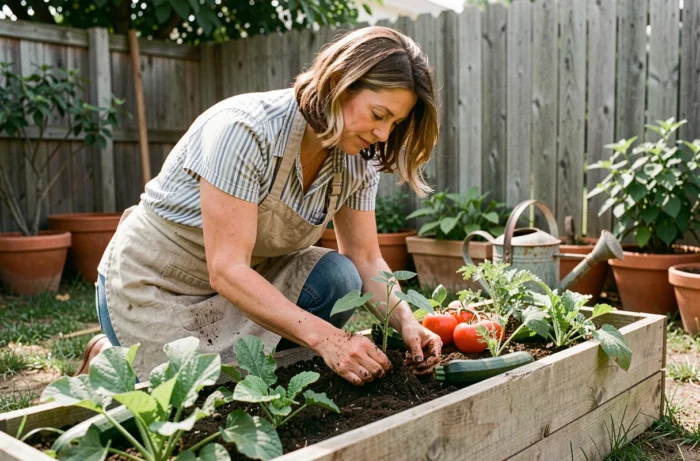
Clay soil that sticks to your boots after every rain, a northwest-facing balcony with three hours of sunlight in summer, slugs that devour salad seedlings overnight: you don’t start an organic vegetable garden under the same conditions depending on the terrain. Before choosing varieties or ordering seeds, the first step is to observe what is actually happening at home, at ground level.
Phytosanitary regulations: what the law already imposes on the home garden
Since July 1, 2022, no synthetic plant protection product can be used in a private garden, including vegetable gardens and ornamental spaces. The ban targets the location, not just the buyer: even a landscaper working at your home can no longer spray herbicides or chemical insecticides. Only three categories of products remain authorized: biocontrol, low-risk products, and products usable in organic farming.
The next step concerns fertilizers. The Climate and Resilience Law provides for the prohibition of the sale, possession, and use of synthetic fertilizers for non-professional use by January 1, 2027, at the latest. In practical terms, the boundary between “traditional garden” and “organic vegetable garden” is fading legally. It’s better to anticipate now by adopting organic fertilizers (homemade compost, composted manure, green manures) rather than having to change habits in a few months.
You can still find synthetic mineral fertilizers on the shelves of garden centers, but their availability will soon disappear. To deepen your understanding of growing without chemical inputs, the vegetable garden on Jardinage Bio details the principles of natural fertilization suitable for home plots.
Soil diagnosis before the first organic sowings
We often see advice like “add compost” without knowing why. The problem is that sandy soil and clay soil do not react the same way to the same amendment.
Hand clod test
Take a handful of moist soil and squeeze it. If the clod crumbles immediately, the soil is sandy: it drains quickly, retains nutrients poorly, and dries out on the surface between waterings. If it remains compact and holds the shape of your fist, the soil is clayey: it stores water and nutrients but compacts and suffocates roots when poorly managed.
Adapting the amendment to the type of soil makes all the difference for plant recovery. In sandy soil, prioritize mature compost spread in a thick layer to improve water retention. In clay soil, incorporate coarser compost or even branch chippings to aerate the structure.
Observe bio-indicator plants
The weeds present before any sowing tell you a lot. Dandelion indicates compacted soil. White chickweed grows in nitrogen-rich soils. Bindweed often indicates a plow pan or excess lime at depth.
Noting these plants over a complete season avoids costly mistakes. You do not correct acidic soil the same way as calcareous soil, and not all vegetables tolerate the same conditions.
Crop associations in the organic vegetable garden: combinations that really work
Plant association charts circulate everywhere, but feedback varies on this point depending on regions, varieties, and microclimates. Rather than an exhaustive list, let’s focus on three combinations whose effects are measurable in the garden.
- Carrot and leek side by side: the carrot fly is repelled by the smell of the leek, and vice versa for the leek moth. Alternate rows, staggering sowing dates to avoid root competition.
- Tomato and basil in the same bed: basil attracts beneficial pollinators for tomato setting and limits certain aphids. Plant it at the base of the tomatoes, not a meter away.
- Climbing bean, corn, and squash (milpa): the bean fixes atmospheric nitrogen in the soil through its root nodules, corn serves as a support, and the large squash leaves cover the ground to slow evaporation and weeds.
These associations do not replace crop rotation over several seasons. Alternating botanical families from year to year (solanaceae, cucurbits, legumes, lilies) remains the most reliable method to avoid the accumulation of diseases in the soil.
Water management and mulching: reduce watering without stressing the plants
Watering every evening with a hose is not care, it’s waste. A properly mulched soil significantly reduces water needs, and roots dive deeper when they do not find water on the surface with every watering.
Which mulch to choose according to the crops
For tomatoes, zucchinis, and squashes, a layer of wheat straw or dried hay works well. It should be applied when the soil is already warmed, not in April on still cold soil. For salads and radishes, a finer mulch (dried grass clippings, shredded leaves) prevents creating a refuge for slugs that is too thick.
Mulch on moist soil, never on dry soil. Mulching preserves the moisture state of the soil at the time it is applied. Putting mulch on dry soil amounts to isolating the dryness.
Watering frequency in the organic vegetable garden
Water generously but less frequently. Deep watering two to three times a week is better than a superficial pass every day. Drip irrigation placed under the mulch remains the most economical solution: water reaches the roots directly without wetting the foliage, which limits the development of downy mildew and powdery mildew on sensitive crops like tomatoes or zucchinis.
Mornings are preferable to evenings for watering. Foliage that remains wet all night promotes fungal diseases, especially in hot and humid periods.
Successfully growing an organic vegetable garden at home depends less on the available space than on the quality of initial observation. An honest soil diagnosis, thoughtful associations, and well-placed mulching solve most problems before they even arise. The rest is learned season after season, with your feet in the soil.