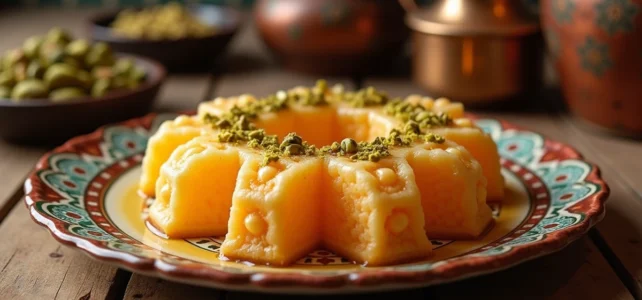
The khaliat nahl, sometimes written khaliya al nahl, is a brioche-like bread in small balls, filled and then coated with a honey syrup. Its name literally means “bee’s nest” in Arabic, referring to the honeycomb shape that the dough balls take once packed into the mold. Originating from Yemen and more broadly from the Arabian Peninsula, this Eastern sweet is distinguished by its fluffy texture, similar to a brioche, and its versatility.
It can be served in both sweet and savory versions.
Khaliat nahl: honeycomb brioche, not flaky pastry
Have you ever tasted baklava or chebakia? The khaliat nahl is nothing like them. While most Eastern sweets rely on layers of filo pastry or semolina, the khaliat nahl starts with a yeast dough similar to brioche. Flour, warm milk, baker’s yeast, a bit of melted butter, and a touch of sugar: the base resembles what you would use for homemade milk bread.
Each dough ball contains a filling, and then the balls are arranged side by side in a round or rectangular mold. During baking, they puff up and stick together, forming that bumpy surface reminiscent of the cells in a beehive. The honey syrup poured over them right out of the oven seeps into the crevices, resulting in a texture that is both melting and slightly sticky, without being cloying.
To find the proportions and the complete preparation process, the khaliya al nahl recipe on Mademoiselle Caramel details each step precisely.

Fillings and variations of khaliat nahl
The most common sweet version uses cream cheese or fresh cheese as a filling. A small spoonful is placed in the center of each dough ball before sealing it. After baking and glazing, the contrast between the sweet syrup and the slightly tangy center of the cheese creates a balance that explains the success of this recipe.
Savory version for appetizers or brunch
A savory variation exists and is worth trying. The cream cheese is replaced with a stronger cheese (like halloumi or feta), the syrup is omitted, and the balls are brushed with a mixture of beaten egg with nigella or sesame seeds. The result works very well for brunch or as an accompaniment to soup, making the khaliat nahl adaptable to a complete meal.
- Classic sweet filling: cream cheese or fresh cheese, hot honey syrup poured over
- Savory filling: feta, halloumi, or stretched cheese, nigella or sesame seeds on top
- Mixed filling (less common): date paste or crushed almonds instead of cheese, for a fully plant-based version
Dough preparation and baking: the points that change the result
The success of khaliat nahl relies on two often rushed steps: kneading and rising time. The dough must be worked until it becomes soft and slightly elastic, without sticking to your fingers. If it remains sticky after kneading, it’s better to add flour in small amounts rather than forcing it.
Two successive rises ensure an airy crumb. The first rise is done as a mass, in a covered bowl, until the dough doubles in size. After shaping the filled balls, a second rise in the mold allows the balls to touch and start to merge even before going into the oven.
The honey syrup: temperature and timing
The syrup is prepared during baking. Water is heated with sugar and honey until a light syrup is obtained, not too thick. Some versions add a splash of orange blossom water, enhancing the Eastern flavors without masking the taste of honey.
Pour the syrup over the balls as soon as they come out of the oven, when the dough is still hot. It is this thermal shock that allows the syrup to penetrate deeply rather than staying on the surface. Waiting for the bread to cool before glazing is the most common mistake: the result will be dry inside and sticky outside.
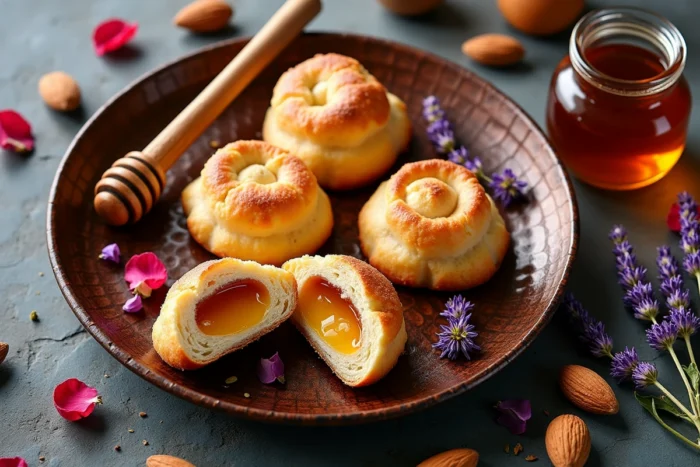
Khaliat nahl with honey: storage and serving
This brioche bread is ideally consumed warm, within hours of baking. Served with mint tea, it makes a sweet end to a meal or a generous snack during Ramadan. Some families also prepare it to accompany the ftour, the breaking of the fast.
If you need to store it, cover the mold with plastic wrap and keep it at room temperature. Khaliat nahl reheats well in the oven at low temperature, which reactivates the syrup and restores the softness of the dough. Microwaving also works, but the surface loses its slight crispness.
- Optimal consumption: within two to three hours after baking, still warm
- Short storage: plastic wrap, room temperature, consume within the day
- Reheating: gentle oven for a few minutes, avoid the microwave to maintain texture
Khaliat nahl remains an accessible recipe, with ingredients that can be found in supermarkets. Its spectacular shape impresses at the table, while the preparation does not require expertise in Eastern pastry. The only point of vigilance is to respect the rising times and the hot glazing, two simple actions that make the difference between an ordinary brioche and a true honey-melting beehive.