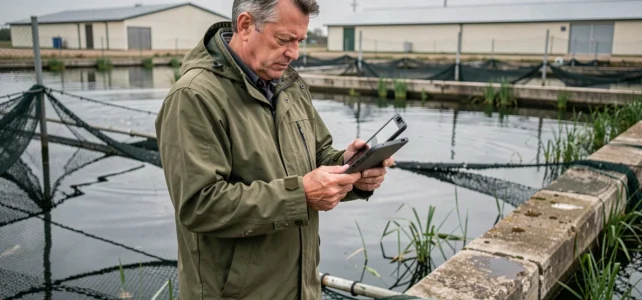
The French fish farming sector remains largely organized around manual management practices: paper breeding logs, water quality monitoring through occasional measurements, supplier orders by phone. This reality hinders traceability, complicates regulatory declarations, and limits operators’ ability to manage their production precisely.
Digitizing a fish farming business is not just about installing sensors in the ponds. The project involves data collection, data utilization, administrative compliance, and networking with other stakeholders in the aquaculture sector.
Regulatory Constraints and Digital Transmission of Operational Data
The digitalization of fish farming is no longer just a lever for optimization. It is gradually becoming a regulatory requirement driven by administrations. In Norway, the food safety authority (Mattilsynet) launched a digital system in 2026 for the operational plans of aquaculture farms, with data made available via an API. Starting in 2027, all Norwegian marine farms will have to submit their operational plans entirely digitally.
This Scandinavian precedent sets the tone. In Europe, Regulation (EU) 2024/1689, known as the “Artificial Intelligence Act,” adopted in June 2024, regulates artificial intelligence systems, including those deployed in aquaculture (computer vision, predictive modeling). Any fish farming business considering integrating these technologies must anticipate compliance with this framework.
For French farms, the trend is clear: digital tools that enable the structuring, storage, and transmission of production data will transition from being an aid to becoming a requirement. Platforms that centralize these flows, as shown by the presentation of My Fish Book, are already positioning professionals in this area by offering them a management and networking space tailored to the sector.
Water Quality and Connected Sensors in Fish Farming
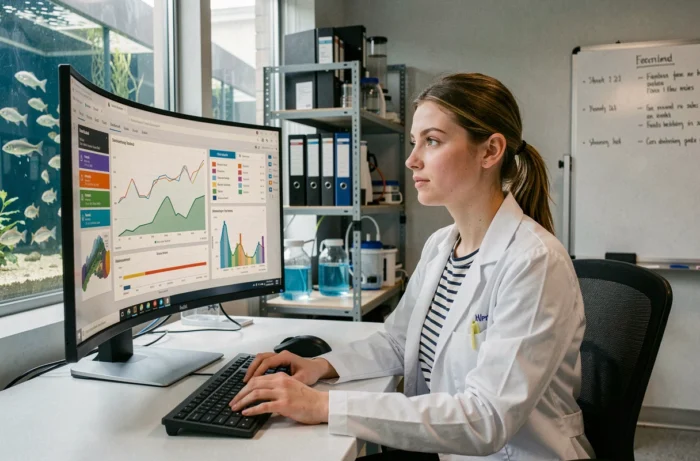
The most critical parameter of a fish farming operation remains water quality. Temperature, dissolved oxygen, pH, salinity: these indicators directly affect fish health, growth, and mortality rates. Manual monitoring, through regular sampling, creates blind spots.
IoT sensor networks change the game. They continuously transmit measurements to a central platform, allowing for the detection of a drift before it causes losses. The SENSORFISH project, funded by the European Union, combined smart sensors and communication technologies for fish production management, involving Canadian, Chinese, and European partners.
However, field feedback varies on the actual cost of these installations for small farms. The equipment (probes, network gateways, power supply in remote locations) represents an investment whose amortization heavily depends on production volume. The available data do not allow for a universal profitability threshold to be established.
- The multi-parameter probe (temperature, oxygen, pH) constitutes the minimal foundation of a connected monitoring system in a pond or lake.
- Network connectivity at rural farming sites remains a frequent technical barrier, sometimes requiring satellite or LoRa solutions.
- Integrating sensor data into a farm management software avoids the multiplication of interfaces and manual re-entries.
Automated Feeding and Data-Driven Management
<p Feeding represents the largest cost in fish farming. Distributing too little slows growth. Distributing too much generates waste and degrades water quality due to excess organic matter. Adjusting feeding in real-time reduces both risks simultaneously.
Programmable systems adapt the quantities distributed based on observed feeding behavior and estimated biomass. Cargill, for example, has developed a predictive platform that uses machine learning and sensors to correlate animal size, water quality, feeding habits, and weather conditions. The generated recommendations focus on feeding management strategy.
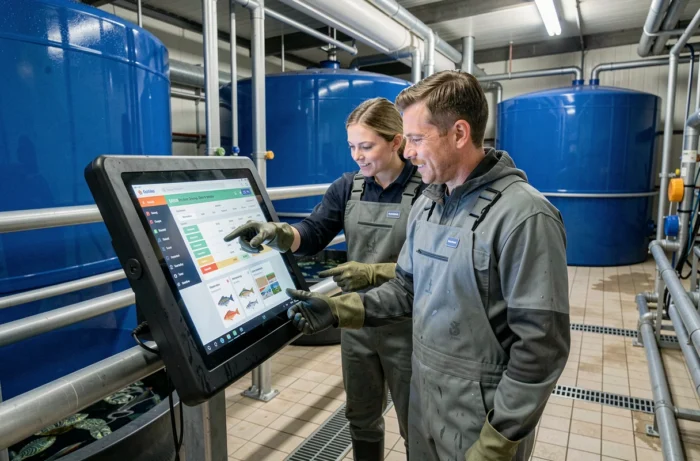
These tools assume a reliable and continuous data flow. Without properly calibrated sensors and a structured production history, predictive algorithms produce recommendations that are not actionable. The digitalization of feeding only makes sense if it relies on an existing data infrastructure.
Networking Stakeholders in the French Aquaculture Sector
The digitalization of a farm is not limited to its ponds. A fish farming business interacts with feed suppliers, analysis laboratories, transporters, fishmongers, and administrations. The digital fragmentation of these exchanges slows down the entire chain.
Sector-specific platforms that connect aquaculture professionals offer a concrete advantage: they centralize commercial exchanges, traceability documents, and certifications in a common space. For the French sector, where farms are spread across many regions with varied productions (trout, bass, sea bream, carp), this networking also facilitates access to new markets.
- A shared digital space simplifies the transmission of health certificates and transport documents between producers and buyers.
- The online visibility of French fish farms remains low compared to other agricultural sectors, which hinders commercial development.
- Integrated management tools (stocks, orders, invoicing) reduce administrative time and free up time for technical monitoring of farms.
The development of fish farming in France also depends on the ability of businesses to become visible and structure their exchanges. Farms that adopt digital tools suited to their sector gain operational efficiency, but also attractiveness for employment, a significant issue in a sector struggling to recruit.
The digital transition of French fish farming will not happen all at once. It progresses in stages, dictated both by the budget constraints of operators, the maturity of available solutions, and the European regulatory pressure that, year after year, makes manual management increasingly difficult to maintain.