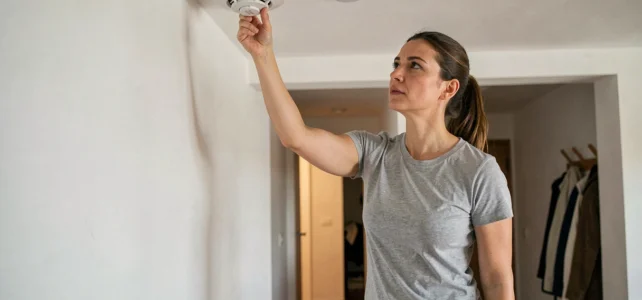
A smoke detector that triggers without visible smoke poses a specific technical problem. Identifying the cause requires distinguishing between a hardware defect and a normal sensor reaction to an invisible stimulus. Your fire alarm sounding for no reason in your apartment is, in the vast majority of cases, due to three mechanisms that we detail here from a technical perspective.
Dirty optical chamber: the most underdiagnosed false positive
The detection principle of a smoke detector relies on an optical chamber where an infrared LED emits a light beam. When smoke particles enter this chamber, they scatter the light towards a receiving photodiode, triggering the alarm. The problem arises when fine dust particles mimic the optical behavior of smoke.
We observe that this phenomenon particularly affects urban apartments located on lower floors, close to roadways or construction sites. Mineral micro-particles accumulate on the internal walls of the chamber and on the lens of the receiver, gradually lowering the triggering threshold.
A simple external dusting with a cloth is not enough. The casing must be opened, access the detection chamber, and use a can of compressed air from a distance of the photodiode to avoid damaging the component. For models with a non-removable chamber, replacing the detector remains the only reliable solution.
When a fire alarm sounding for no reason in an apartment persists despite cleaning, we recommend checking whether the installed model uses optical or ionic technology, as the response differs depending on the sensor.

Sealed lithium battery and end of life of the smoke detector: two signals not to confuse
Recent detectors come with a non-replaceable sealed lithium battery, designed to last the entire lifespan of the device, typically around ten years. When this battery runs low, the detector emits a short beep every 30 to 60 seconds. This signal is radically different from the continuous alarm triggered by smoke detection.
The confusion between the two signals is common. An intermittent beep indicates a low battery. A continuous siren means active detection. On a model with a sealed battery, no intervention on the battery is possible: the complete replacement of the unit is required.
Check the manufacturing date printed on the back of the detector. If it is over eight years old, the sensor itself may have drifted, producing false alerts even with a still functional battery. The EN 14604 standard imposes a maximum lifespan indicated by the manufacturer, but no regulatory mechanism forces replacement in practice.
Distribution of responsibilities since June 2025
Since the update that came into effect on June 13, 2025, Article R.142-3 of the Construction and Housing Code specifies the distribution: the owner installs, the occupant maintains and renews if necessary. In co-ownership, a tenant faced with an end-of-life detector must therefore replace it at their own expense, unless otherwise stated in the lease.
Water vapor, aerosols, and volatile organic compounds: the invisible triggers
An optical smoke detector cannot distinguish between combustion smoke particles and suspended water droplets. Steam produced by a hot shower, a pot of boiling water, or an iron can trigger an alarm identical to that of a fire outbreak.
Three situations cause the majority of false positives related to the environment:
- High-temperature cooking without an exhaust hood, particularly frying and gas grilling, which release greasy particles suspended in the ambient air
- Use of aerosols (hairspray, air freshener, insecticide) in direct proximity to the detector, whose micro-droplets enter the optical chamber
- Bathroom adjacent to a hallway where the smoke detector is installed, with insufficient mechanical ventilation allowing humidity to migrate
The solution lies in repositioning the detector. Regulations require installation on the ceiling, but a minimum distance of three meters from any steam source significantly reduces false triggers. In a studio or a T2 with an open kitchen, maintaining this distance may prove impossible: we then recommend a dual-sensor model (optical and thermal), less sensitive to vapors not related to a fire.

Smoke detector and carbon monoxide detector: a confusion to clear
The DGCCRF reminded in 2025 that the carbon monoxide detector is not mandatory in French homes, unlike the smoke detector. In an apartment equipped with a gas boiler or water heater, a beep from a device mounted on the wall (and not on the ceiling) may indicate a CO concentration, not a smoke issue.
Confusing the two devices delays the appropriate reaction. A CO detector that beeps requires immediate ventilation and evacuation of the premises. A smoke detector that beeps intermittently requires a battery or device replacement. Check the label printed on the unit: “smoke detector” or “CO detector” designates two devices with opposing response protocols.
Reset procedure before replacement
Before discarding a detector that seems faulty, try a reset. Remove the battery (if the model allows), hold the test button for fifteen seconds to discharge the residual capacitor, then reinstall the battery. If the beep resumes within the next 24 hours, the sensor is at the end of its life.
- Beep every 30 seconds after reset: battery or sensor faulty, replacement necessary
- Continuous alarm without smoke or steam after reset: electronic circuit fault, complete unit replacement
- No signal after reset: normal operation restored, monitor for a week
A smoke detector sounding for no reason remains a signal to take seriously, even when the cause is benign. Each unresolved false alert drives occupants to remove the batteries or disconnect the device, which eliminates any protection in the event of a real fire outbreak. Replacing a smoke detector costs less than twenty euros and takes two minutes: it is the most cost-effective gesture in terms of home fire safety.