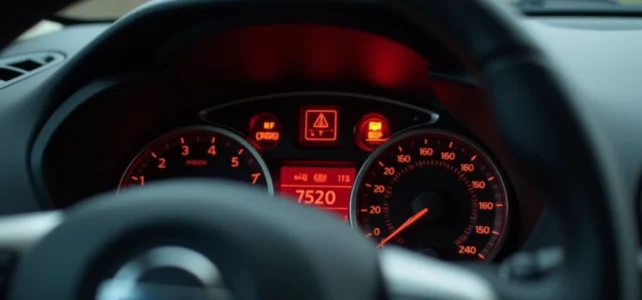
On the Nissan Juke, the simultaneous illumination of the red engine light and the ESP warning light on the dashboard indicates communication between control units. The engine management system detects an anomaly, and the ESP control unit goes into fault mode as a protective measure. This coupling is not a coincidence: it corresponds to a safety strategy designed by the manufacturer, where the degradation of an engine parameter leads to the deactivation of stability control.
Battery voltage and electrical supply: an underestimated cause on Nissan Juke
Most online discussions point to wheel sensors or the ABS circuit when the ESP light comes on. On the Juke, the reality is often more mundane: a weak battery or unstable voltage is enough to trigger simultaneous faults.
The ESP control unit and the engine control unit share the same electrical supply. When the voltage drops below a certain threshold (difficult starting, weakening alternator), both modules register fault codes without any mechanical part actually being faulty. To better understand the red engine light and ESP on a Nissan Juke, this electrical cause must first be ruled out before looking further.
A blown ESP/ABS fuse or a damaged harness at the hub can produce the same clinical picture. On Jukes with a few years of use, corrosion of the sensor connectors at the wheel arch remains a common cause that the diagnostic tool does not always locate on the first pass.
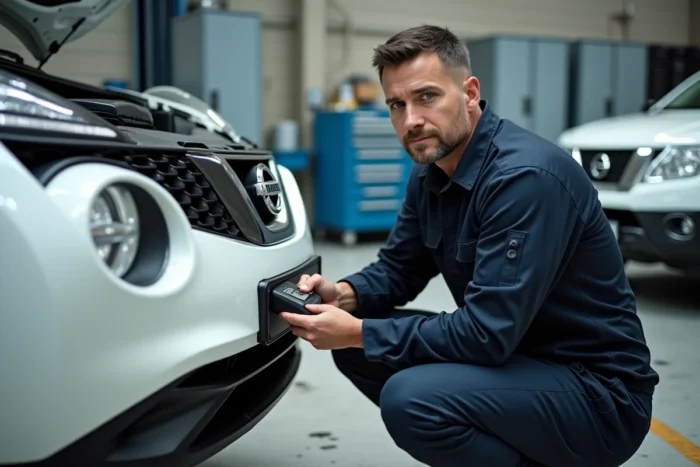
Red engine light on Juke 1.5 dCi: link with the intake circuit and turbo
On the Juke 1.5 dCi, the illumination of the red engine light accompanied by the ESP warning does not always originate from the stability system itself. Feedback from owners documents a recurring pattern: the problem comes from the engine, not the chassis.
The intake circuit (clogged EGR valve, faulty boost pressure sensor, leak on a turbo hose) causes an engine fault. The main control unit then reduces the available power. Consequently, the ESP control unit interprets this limitation as an inconsistency and deactivates itself, illuminating its own warning light.
This phenomenon explains why some owners see both lights on without any loss of road handling. The driving behavior remains normal because the ESP has no fault of its own: it reacts to the information transmitted by the engine control unit.
- Clogged EGR valve: causes engine misfires and a drop in torque, sufficient to trigger limp mode
- Crumpled or detached turbo hose: the loss of intake pressure generates a fault code P0299 (turbo underboost) which disables the ESP for safety
- Faulty boost pressure sensor: transmits an inconsistent value to the control unit, which interprets an engine risk
Nissan Juke diagnosis: why the diagnostic tool doesn’t always find the fault
Several owner testimonials describe a frustrating scenario: visiting the dealership, reading with the diagnostic tool, no fault codes displayed. The warning lights return a few days later.
This phenomenon has a technical explanation. Intermittent faults related to electrical voltage clear when the battery returns to a correct charge level (after a highway trip, for example). The control unit does not always retain the history of a one-time fault if the conditions for recording are not met.
For a reliable diagnosis, the reading must occur with the lights on and the engine running. An experienced mechanic will also request the fault history (stored codes and pending codes), not just the active faults. On the Juke, the procedure involves separately checking the engine control unit and the ABS/ESP control unit, as they store their codes independently.
Glow plugs: a common false friend
On the 1.5 dCi, replacing the glow plugs often appears as a “solution” during the first visit to the workshop. The diagnostic tool displays a code related to preheating, the mechanic replaces the plugs, and the lights go out. A few days later, everything lights up again.
The glow plugs are rarely the root cause. They mask a deeper fault (EGR valve, sensor, electrical issue) that does not appear during a quick diagnosis. If the problem returns after replacing the plugs, the search should be directed towards the intake circuit or the battery.
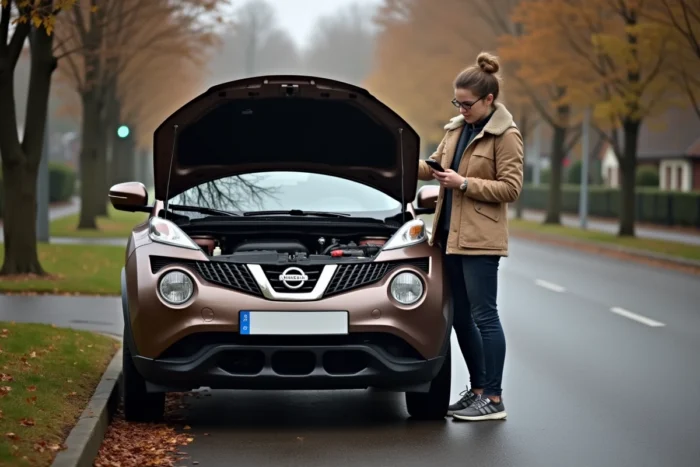
Driving with ESP and engine lights on: real risks on Nissan Juke
The question arises systematically: should you stop immediately? The answer depends on the engine light.
A red engine light means stopping as soon as possible. Red indicates a risk of mechanical damage (overheating, oil pressure, serious problem). Additionally, the deactivated ESP means that the vehicle no longer benefits from electronic correction in case of loss of grip.
The combination of the two requires cautious driving:
- Reduce speed and avoid sudden maneuvers, as stability control will not compensate for a skid
- Monitor the engine temperature on the dashboard: if the needle rises into the red zone, stop immediately
- Do not ignore the light on the pretext that “the car drives normally”: the absence of a perceptible symptom does not guarantee the absence of ongoing damage
On the Juke, limp mode intentionally limits power. This electronic throttle protects the engine but does not exempt from a quick check. Driving for several weeks with these two lights on exposes you to engine failure if the cause is mechanical, or a simple battery change if the cause is electrical. Only a precise diagnosis can clarify the situation.