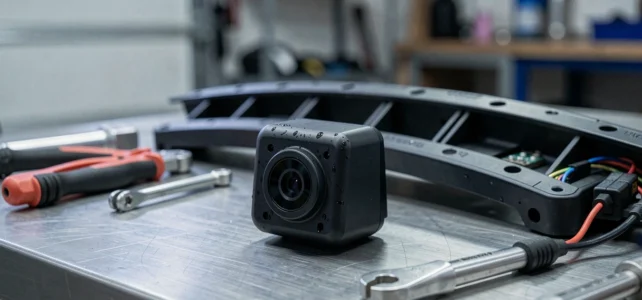
Parking a compact SUV in the city without hitting the rear bumper is a stress everyone knows. On the second-generation Volkswagen T-Roc, the rearview camera no longer just displays a blurry image on a small screen. It becomes the center of a complete system that combines vision, alerts, and automated assistance. Here’s what the 2026 generation changes concretely.
Area View on the T-Roc: 360° vision replaces the standard rear camera
Have you noticed that a standard rearview camera only shows what’s happening behind the vehicle? A pedestrian approaching from the side or a low pole on the left flank remains invisible. The 2026 T-Roc addresses this issue with the Area View system, a 360° view around the vehicle.
This device combines several sensors to recreate a bird’s-eye view of the SUV and its immediate surroundings. The screen simultaneously displays the rear view and the overhead view. The driver sees in real-time the obstacles on all four sides, not just in the reversing axis.
In some markets, Area View is offered in higher trims or via an optional package. The new rearview cameras for the T-Roc thus represent a significant technological leap compared to the first generation, which was limited to a single sensor housed in the tailgate emblem.
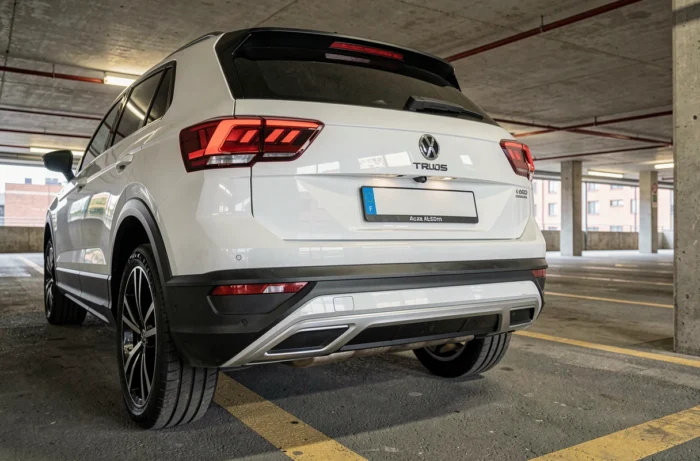
Rear traffic alert and exit warning: two rear safety features to know
The camera alone, even in high definition, is not enough. Why? Because it relies on the driver’s attention. When backing out of a space, the focus often shifts to just one side.
The 2026 T-Roc integrates two assistances in several markets that complement the camera vision:
- Rear traffic alert: sensors detect vehicles approaching laterally from behind. If another driver enters the parking aisle while you are reversing, the system triggers an audible and visual alert, even emergency braking.
- Exit warning: when opening the doors, the system monitors the arrival of cyclists or cars. A signal warns passengers before they push the door into traffic.
- Together, they form a camera block, rear assistance, and exit alert, much more protective than a simple rear image displayed on the screen.
This evolution is consistent with the score achieved by the 2026 T-Roc in Euro NCAP tests: five stars, with particularly high results in the driving assistance category. The Front Assist system with nighttime detection of pedestrians and cyclists complements the front setup.
Standard rearview camera on the T-Roc 2026: what changes compared to the old model
On the first generation of the T-Roc, the rearview camera was on the options list. Depending on the chosen trim, it was sometimes necessary to select an additional package to obtain it. The total budget for the vehicle was affected.
The second generation changes the game. The rearview camera is included as standard in several markets, starting from the entry-level versions. This choice reflects a broader trend in the compact SUV segment: rear vision is becoming standard equipment, just like ABS or side airbags a few years ago.
In practical terms, buyers no longer have to choose between a camera and another option. The image is displayed on the central touchscreen of the multimedia system, with dynamic guiding lines that follow the steering angle. The resolution has improved compared to the previous model, making maneuvers in poorly lit underground parking lots easier.
Retrofit or original installation: can you add a camera to an older T-Roc?
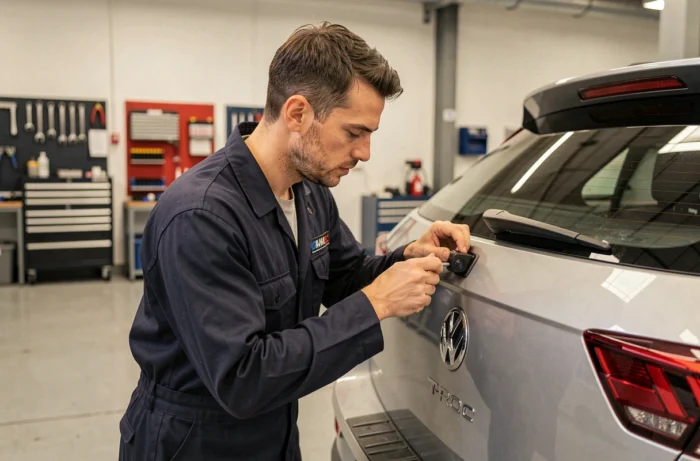
For owners of the first-generation T-Roc, retrofit kits are available. They integrate a sensor into the original rear emblem and connect to the Discover Media multimedia system. Installation requires specific software coding, which usually involves a visit to a specialized workshop.
The image quality remains below that of the native camera of the 2026 model, but the comfort gained in maneuvering is real. A well-installed retrofit kit transforms tight parking into a mundane exercise.
Intelligent Park Assist and camera: towards semi-autonomous parking
The 2026 T-Roc does not just show what’s happening behind. It also offers to park for you, or almost. The Intelligent Park Assist system uses the camera combined with ultrasonic sensors to identify a free space, calculate the trajectory, and steer the direction.
The driver keeps their foot on the brake and controls the speed. The steering wheel turns by itself. This semi-autonomous operation works for parallel parking and angled spaces. On the most equipped trims, the vehicle also manages the reverse exit from parking.
The 2026 equipment packages increasingly combine the camera with semi-autonomous driving functions, such as lane keeping or adaptive cruise control. The rear camera is no longer an isolated tool: it participates in a network of sensors that cooperate to secure each maneuver.
What this means for competing models
The Renault Captur and Peugeot 2008, the main rivals of the T-Roc in Europe, also offer rearview cameras and parking aids. The difference lies in the integration. Volkswagen focuses on an ecosystem where each sensor feeds the others, rather than on isolated functions.
Choosing a compact SUV in 2026 thus depends as much on the quality of the camera-assistance block as on the engine or design. Safety in maneuvering becomes a fully-fledged comparison criterion among models in the segment.