
A brief and intense sensation passes through the skull, like a flash of lightning. It sometimes occurs when turning the head, sometimes for no apparent reason. This phenomenon has a common name in medical vocabulary: electric shock in the head. Behind this sensation lie several distinct mechanisms, and identifying them radically changes the management.
Withdrawal from antidepressants and brain zaps: an underestimated cause
Have you recently stopped or reduced an SSRI or SNRI antidepressant? The cranial electric shocks that appear in the days or weeks following this change have a name: brain zaps. This term refers to very brief, diffuse sensations, often triggered by a simple movement of the eyes or head.
Unlike neuralgias, these shocks do not follow the path of a specific nerve. They do not cause localized facial pain or a reaction to touch. It is this absence of an identifiable starting point that distinguishes them. Brain zaps typically occur during a rapid withdrawal or a dose change that is too quick of psychotropic drugs.
An article detailing the causes of electric shocks in the head reminds us that this withdrawal symptom is often confused with other neurological conditions, delaying the appropriate therapeutic response.
A gradual resumption of treatment or a slower withdrawal usually suffices to make these episodes disappear. The prescribing doctor remains the first point of contact to adjust the protocol.

Arnold’s neuralgia and trigeminal neuralgia: locating the pain to identify the nerve
When the shock follows a specific path, the possibility of a neuralgia becomes probable. Two nerves are most often involved, and the location of the pain allows for a fairly clear differentiation.
Shocks at the back of the skull: the Arnold nerve
The Arnold nerve (or greater occipital nerve) originates from the base of the skull, at the junction between the first cervical vertebrae. When it is compressed or irritated, the pain travels like a flash from the neck to the top of the skull, sometimes reaching the eye.
Rotation or tilting of the head often triggers the episode. Chronic cervical tension, prolonged poor posture, or trauma to the cervical spine are among the common triggering factors. The diagnosis relies on clinical examination and sometimes a cervical MRI to rule out a structural lesion.
Shocks in the face: the trigeminal nerve
Trigeminal neuralgia produces shocks of an intensity often described as unbearable. The pain affects one half of the face (cheek, jaw, forehead) and stops abruptly at the midline, never crossing to the other side.
A light touch on the skin, chewing, talking, or even a draft can be enough to trigger the episode. The main cause is compression of the nerve by a blood vessel at its exit from the brainstem. An MRI can visualize this vascular-nerve conflict and guide treatment, which ranges from antiepileptic medication to microsurgery in resistant cases.
Small fiber neuropathy: the post-viral lead
Since the COVID-19 pandemic, doctors have reported an increase in patients describing electric sensations on the scalp, without identifiable neuralgia. These symptoms point towards a small fiber neuropathy.
These very fine nerve fibers transmit sensations of temperature and superficial pain. When they malfunction, they generate burning, tingling, or shocks in areas unusual for classic neuralgia.
Diabetes remains a known cause of this type of neuropathy. Post-viral syndromes, particularly after infection with SARS-CoV-2, constitute a more recent cause. The diagnosis relies on a rarely prescribed first-line examination: skin biopsy, which allows for quantifying the density of small nerve fibers in the skin.
Recognizing the type of shock to guide the consultation
When faced with an electric shock in the head, three elements allow for a quick orientation of thought before consulting:
- Location: pain that follows a specific path (back of the skull, one half of the face) points towards a neuralgia. A diffuse sensation, without an identifiable path, suggests brain zaps or small fiber neuropathy.
- Trigger: a movement of the head or neck suggests the Arnold nerve. A light touch on the face evokes the trigeminal nerve. A recent change in psychotropic treatment points towards withdrawal.
- Medical context: a history of recent viral infection, diabetes, or medication withdrawal completely changes the initial hypothesis.
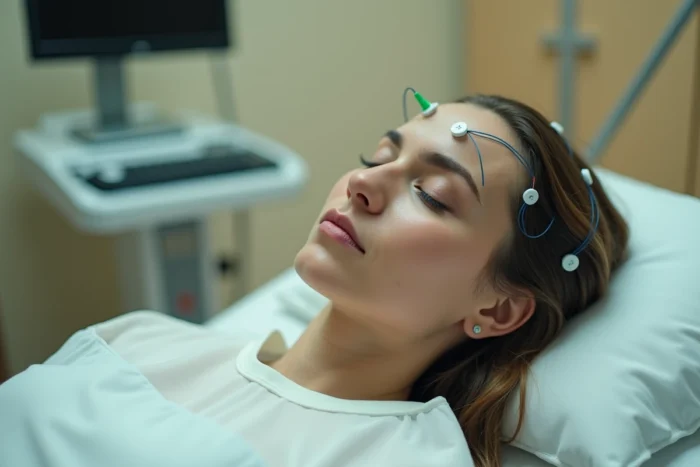
The general practitioner can make an initial clinical diagnosis. Depending on the cases, they will refer to a neurologist for an MRI, a neurophysiological assessment, or a skin biopsy.
Consult quickly if the pain is accompanied by visual disturbances, weakness on one side of the body, or speech difficulties: these associated signs require urgent management to rule out a stroke. Outside of this emergency framework, the vast majority of cranial electric shocks are due to identifiable and treatable mechanisms once the correct diagnosis is made.