
Estimating the value of your home before a sale, an inheritance, or a refinancing involves choosing between several levels of service. Some are free, while others cost several hundred euros. Price does not summarize the issue: it is the legal value of the document obtained, its degree of precision, and the independence of the professional that guide the choice.
Legal value of an estimate: what separates a value opinion from an opposable expertise
A free value opinion, whether produced by a simulator or by a real estate agent after a visit, remains a non-opposable commercial act. It only slightly engages the responsibility of the professional who signs it.
A paid market value expertise, carried out by a certified expert, is based on a formalized methodology. It engages the civil liability of the expert and can be presented before a judge, a notary, or the tax administration. It is this dimension of opposability that justifies the cost.
In practical terms, if you are going through a divorce, a tax audit, or a complex inheritance division, a free value opinion will not be sufficient. A comprehensive guide on real estate estimation on Verita Press details the cases where each formula finds its relevance. For a classic sale without disputes, the free value opinion serves its purpose.

Free online estimation or by an agent: reliability and concrete limits
Online simulators cross-reference data from recent transactions, surface area, location, and type of property. They produce a price range in a few minutes. This range gives a rough idea, not a directly exploitable sale price.
The free estimation by a real estate agent goes further. The agent visits, observes the condition of the property, evaluates the features (equipped kitchen, insulation, brightness), and compares with recent sales in the neighborhood. The agent also assesses local demand at a given moment, which no algorithm captures with the same finesse.
Both approaches share a limitation: the agent who estimates your house for free hopes to secure a sales mandate. This commercial logic does not systematically skew the result, but it influences the relationship. The free estimation does not require signing a mandate (the regulations governing the activities of real estate agents protect on this point), however, the agent has an objective interest in subsequently offering you their services.
What online tools do not capture
- The actual condition of the property after a visit: a recent facelift, an aging roof, or an unfavorable energy performance diagnosis significantly alter the value, and these elements do not appear in automated databases.
- The micro-market: two streets in the same neighborhood can show significant price differences depending on exposure, noise, or proximity to a business. Algorithms smooth these nuances.
- The personal context of the seller: an occupied property, a property in joint ownership, or a property burdened with an easement does not value the same as a property free of any constraints.
Paid real estate expertise: when the cost is justified
A formal expertise, carried out by a real estate appraisal expert, produces a structured report with a transparent methodology. Fees are generally flat-rate and independent of the value level retained for the property. This mode of remuneration aims to guarantee impartiality: the expert does not earn more by inflating the estimate.
Since the application of provisions governing acts outside of authentic acts, notaries who carry out paid estimates are subject to a written fee agreement. This obligation for formalization protects the client against vague billing and clarifies the exact scope of the service.
Situations where paid expertise is necessary
An inheritance division among disagreeing heirs, a contentious divorce, a tax administration audit on the declared value of a property: in these three cases, only an opposable expertise holds up against an institutional third party. The agency’s value opinion, even if well drafted, will be dismissed.
Field feedback diverges on another point: overvaluation. Some agents, to obtain an exclusive mandate, propose a flattering price that does not correspond to the market. Paid expertise, disconnected from the transaction, does not have this bias. However, it also does not guarantee a sale price: it sets a theoretical market value at a given moment.
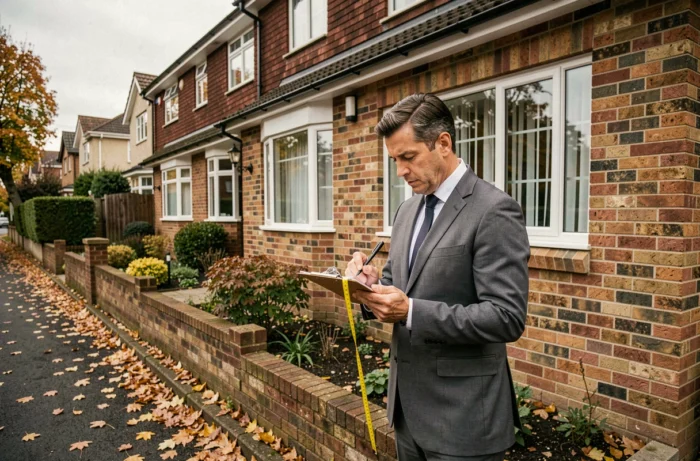
Real estate estimation for a house: how to arbitrate between free and paid
The choice is not just a matter of budget. It depends on the use you will make of the document.
- You are preparing a sale without disputes: the free estimation by an agent, supplemented by one or two online simulators for cross-checking, is sufficient in most cases.
- You need to produce a document for a judge, a succession notary, or the tax office: the paid market value expertise is the only acceptable format.
- You want to know the value of your assets without an immediate sale project (insurance, refinancing, retirement planning): a free value opinion provides a reference, but a paid expertise provides a document usable with a bank or an insurer.
One last point deserves attention. A paid estimation does not necessarily produce a figure closer to the actual sale price than a free estimation carried out by an experienced agent in the sector. The difference lies in the legal solidity of the document, not necessarily in the accuracy of the figure. The right reflex is to cross-check at least two sources, regardless of the formula chosen, to identify discrepancies and adjust your sale price with full knowledge of the facts.