
A crying infant at three in the morning, a bottle to prepare with one hand while the other holds the baby close: the first weeks expose parents to a fatigue that most underestimate. Here, we focus on practical points that really make a difference in daily life, from the new birth leave in 2026 to sleep organization and actions that protect the couple’s health.
Additional Birth Leave 2026: What Young Parents Should Anticipate
Since July 1, 2026, an additional birth leave allows each parent to benefit from one to two months of compensated leave from Social Security. This individual right is in addition to existing maternity, paternity, and parental leaves and can be taken in one or two periods within the nine months following the birth.
The compensation reaches 70% of the net salary in the first month, then 60% in the second, within the limit of the monthly Social Security ceiling for 2026 (€4,005). On paper, this is a real advancement to stay with the baby longer.
In practice, several families have reported delays in the payment of these benefits. Reports in the press mention parents wondering who will pay the rent or buy milk for the baby while waiting for the payment. Before taking this leave, it is wise to build a cash reserve covering at least one month of fixed expenses, while Social Security processes the application.
To explore other practical aspects of parenting (nutrition, sleep, equipment), the Puériculture Bébés blog details these topics by age group.
Infant Sleep and Parent Recovery: A Two-Person Organization
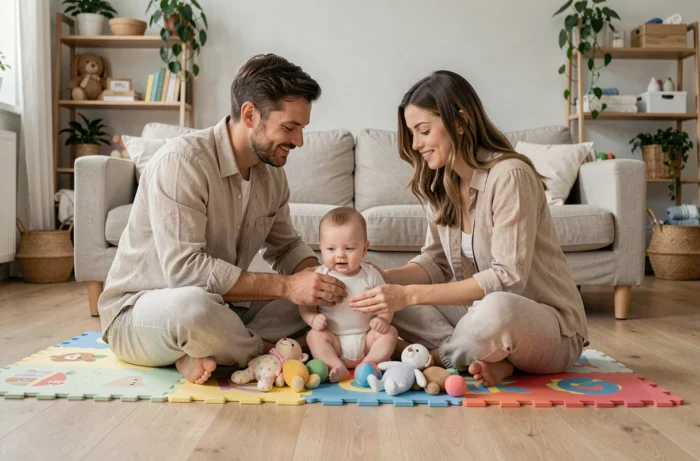
Lack of sleep is the factor that most quickly degrades patience, clarity, and the couple’s relationship. Waiting for fatigue to accumulate before reacting is a common mistake. Organize shifts from the very first days.
The Shift System Rather Than Vague Sharing
Instead of a vague “we’ll take turns,” divide the night into two fixed slots. One parent manages from 9 PM to 2 AM, the other from 2 AM to 7 AM. The one sleeping wears earplugs and sleeps in a separate room if possible. This division guarantees each person a block of four to five hours of continuous sleep, which radically changes recovery compared to micro-awakenings throughout the night.
A block of continuous sleep is better than eight fragmented hours. Feedback varies on the exact duration of the shifts, but the principle of fixed shifts remains the most reliable for sustaining over time.
Putting the Baby to Bed: Concrete Guidelines
Place the infant on their back, on a firm mattress, without a pillow, blanket, or bumper. The room temperature ideally ranges between 18 and 20 degrees. These simple guidelines reduce the risk factors associated with sleeping.
- Use a sleep sack appropriate for the season instead of a blanket, to avoid any covering of the face during the night.
- Keep the crib in the parental bedroom for the first months, making nighttime feedings or bottle feeding easier without crossing the house.
- No objects in the crib (stuffed animals, positioning cushions, baby wedges): a bare mattress with a fitted sheet is sufficient.
Environmental Health in the First 1,000 Days: Important Actions at Home
The French policy for the first 1,000 days has recently shifted towards environmental health. The 2025-2027 roadmap targets reducing exposure to endocrine disruptors and household pollutants starting from pregnancy.
In practice, we act on three levers in the home.
- Ventilate each room for at least ten minutes a day, even in winter. Indoor air contains more volatile compounds (glues, paints, cleaning products) than outdoor air.
- Prefer cleaning products without synthetic fragrances. A mixture of white vinegar and water covers most everyday cleaning needs.
- Wash new baby clothes and bedding before first use to eliminate residues from textile processing.
These actions require neither additional budget nor special equipment. They reduce the infant’s daily exposure to substances that their body metabolizes much less effectively than an adult’s.

Preserving the Couple and Their Mental Health After Birth
Fatigue and the mental load associated with a newborn create pressure that often settles in without parents realizing it. We are not talking here about “taking care of oneself” in a generic sense, but about recognizing concrete warning signs that justify asking for help.
A parent who cries several times a day for no identifiable reason, who feels hostility towards the baby, or who can’t sleep even when the infant is sleeping may be experiencing a postpartum depressive episode. This disorder affects both mothers and fathers. The first useful reflex is to talk to the midwife or the family doctor, not a search engine.
Communication in the Couple: A Weekly Appointment
Set aside a twenty-minute slot each week, without the baby in arms, to discuss the actual division of tasks. Not feelings, not educational projections: just who does what, what’s getting stuck, what we adjust. This regular reframing prevents the accumulation of silent frustrations that can explode at the worst moment.
Accepting external help (grandparents, friends, neighbors) for a grocery run, a meal, or an hour of babysitting is not a sign of failure. It is a recovery lever as effective as a full night’s sleep.
Taking care of an infant daily is less about theoretical knowledge and more about refined logistics and shared vigilance. The additional birth leave offers time, provided you anticipate the payment delays. Sleep is protected by fixed shifts. The home is secured through simple and free actions. The rest adjusts week by week, as the baby grows and the parents find their own rhythm.