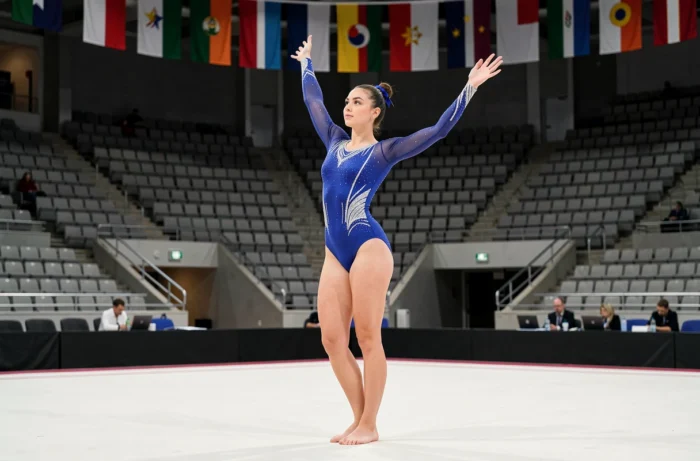
When watching an artistic gymnastics competition at the Olympics or World Championships, the question inevitably arises: does the gymnast on the apparatus represent their country in a team ranking, or are they competing for themselves? The short answer is both, often during the same rotation.
A gymnast’s performance on an apparatus can simultaneously contribute to their team’s score and their individual qualification, blurring the line between solo and team for the uninitiated spectator.
This dual interpretation of a single performance is the pivot of any gymnastics competition. Understanding this mechanism changes the way one follows an event, as can be read on En forme chaque jour in an article detailing the individual journeys of gymnasts.
Qualifications in Artistic Gymnastics: One Performance, Multiple Rankings
On the ground, the operation is very concrete. In artistic gymnastics, the qualifications (called subdivisions) serve as a filter for three distinct types of finals: the team final, the individual all-around final, and the apparatus finals.
A gymnast performs on each apparatus only once in qualifications. Their score is then added to their team’s total, but it also serves for positioning in the individual all-around ranking and in the specific ranking for each apparatus. One performance thus contributes to three different rankings.
This is where team strategy comes into play. The number of gymnasts allowed to compete on each apparatus for the team is limited. The technical staff must therefore choose which athletes to align on which apparatus, taking into account both the collective score and each individual’s ambitions.
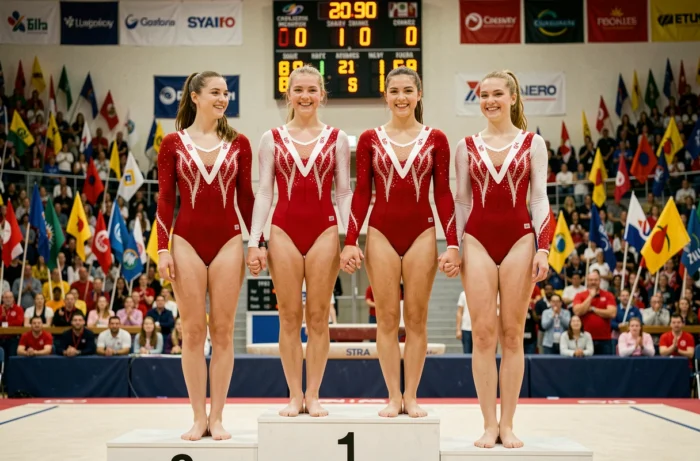
Final Formats in Gymnastics: Team, All-Around, and Apparatus
After the qualifications, the three types of finals operate completely independently. The team final pits the best qualified nations against each other. The gymnasts then compete only for the collective total, and the medal is shared.
The individual all-around final brings together the highest-ranked gymnasts based on the cumulative scores from all apparatuses. Here, each athlete is alone in facing their ranking. For men’s artistic gymnastics, there are six apparatuses (floor, pommel horse, rings, vault, parallel bars, high bar), and four apparatuses for women (vault, uneven bars, balance beam, floor).
The apparatus finals isolate the specialists. A gymnast can be a finalist on the balance beam without having reached the all-around final, allowing those with a strong profile on one apparatus to win a title.
Quotas and the Two Per Country Rule
A constraint limits each nation’s representation in individual finals: no more than two gymnasts from the same country can qualify for the individual all-around final or for a specific apparatus final. This rule, in effect at the Olympics, means that a gymnast with an excellent score in qualifications can be excluded if two of their compatriots rank higher.
- Team final: qualified nations compete collectively, the total of the best scores per apparatus determines the ranking
- Individual all-around: gymnasts are ranked based on the sum of all apparatus scores, maximum two per country
- Apparatus finals: a ranking per apparatus, maximum two gymnasts per country and per apparatus
- Gymnasts without a qualified team: some athletes earn individual spots and only participate in individual events
Rhythmic and Acrobatic Gymnastics: Different Group Logics
This moves us away from artistic gymnastics to disciplines where the notion of team takes on a physical meaning, not just a numerical one.
In rhythmic gymnastics, the individual discipline and the group discipline (ensemble) are two distinct specialties with their own Code of Points. Gymnasts in a group of five perform synchronized exercises with apparatus, and their score is collective by nature. The new FIG Code 2025-2028 has also modified the composition of group exercises, changing the combinations of apparatus used throughout the cycle.
In the individual discipline, the gymnast constructs their program alone, with complexity focused on their own physical and manipulation abilities. Feedback varies on this point, but the recent trend is towards a reduction in the number of body difficulties taken into account, pushing individualists to focus on execution quality rather than accumulation.

Acrobatic Gymnastics: The Collective as the Native Format
Acrobatic gymnastics operates exclusively in collective formations: duos, trios, or quartets. There is no individual event. The ranking pits groups against each other, and the score reflects the collective performance, including lifts, catches, and synchronized choreographic elements.
In acrobatic gymnastics, competing alone is simply not an option. The sport is designed around physical trust between partners, making it a unique case within the family of gymnastic disciplines.
Trampoline and Tumbling: Individual Events with Team Competition on the Side
Trampoline and tumbling are predominantly individual disciplines. Each gymnast performs their routines alone, and the ranking is strictly personal. At the Olympics, only individual trampoline is included in the program.
Outside the Olympic framework, some championships organize synchronized trampoline team events, where two athletes jump simultaneously on two side-by-side trampolines. The score then incorporates a synchronization criterion in addition to difficulty and execution.
- Individual trampoline: only Olympic format, strictly personal ranking
- Synchronized trampoline: two gymnasts side by side, score including synchronization, format outside the Olympics
- Tumbling: individual events, team ranking sometimes added during national or continental championships
Competitive gymnastics is therefore not limited to a binary choice between solo and team. Depending on the discipline, the same athlete can be both a team member and a contender for an individual title on the same competition day. In artistic gymnastics, this is even the norm. In acrobatic gymnastics, the collective is the only path. In trampoline, the individual predominates. The format depends as much on the discipline practiced as on the level of competition aimed for.